In early August 2026, the upper stage of the Falcon 9 launch vehicle, belonging to SpaceX, struck the lunar surface, leaving behind a noticeable crater. According to data cited in materials from Xbt.com and confirmed by several publications, the collision occurred on August 5 of this year. The approximately four-ton spacecraft hit the Moon's surface at a speed of around 8,700 kilometers per hour, which produced the crater and characteristic ejecta around the impact point.
Impact at 8,700 km/h
According to available information, at the moment of contact with the surface the stage had accelerated to approximately 8,700 km/h. It is precisely this speed and the mass of the object that explain the scale of the trace: the crater measured about 18 meters in width, and radial ejecta formed around the impact point. Initially, before-and-after footage of the fall was transmitted by the South Korean lunar orbiter Danuri (Koreun), but subsequent images significantly expanded scientists' ability to analyze the consequences of the collision.
Six days waiting for LRO
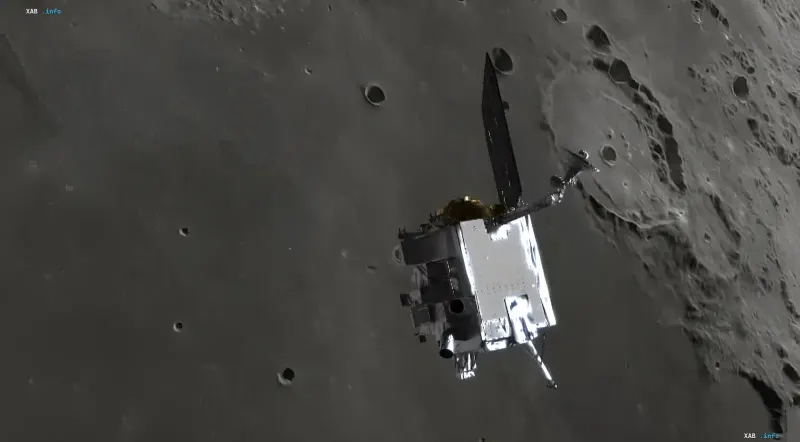
As agency representatives explained, the Lunar Reconnaissance Orbiter (LRO) had to wait about six days for the relevant surface area to come into view of its camera. This is due to the orbiter's orbital mechanics: a specific point on the Moon becomes available for imaging only at certain moments of its pass. In the end, images were obtained from different angles and under different lighting conditions, which allowed specialists to accurately assess the geometry and features of the crater.
What the images showed: streaks and an 18-meter crater
Working with the obtained images, researchers detected various light and dark streaks around the crater — traces of ejected soil and changes in the surface albedo in the impact zone. The contrast of these streaks against the lunar regolith helped better understand the dynamics of the collision and the distribution of material. According to the estimate given in the publications, the crater is about 18 meters wide, making it one of the notable artificial traces on the lunar surface.
Why the stage headed to the Moon
The reason for the trajectory is explained by the rocket's design logic: after separating the payload, the upper stage had insufficient fuel remaining to return to Earth. As a result, the object continued moving by its own inertia, entered a lunar trajectory, and ultimately struck the Moon's surface in August, leaving a large-scale trace that is now being documented by scientific missions.
Contradictory data
Different materials emphasize the role of specific spacecraft in recording the event in different ways: some sources stress that the initial before-and-after footage of the fall was transmitted by the South Korean orbiter Danuri, while others focus on the detailed LRO images obtained a few days later. In addition, the exact width of the crater (around 18 meters) is not given in all publications — in some materials the crater size is not specified. These discrepancies concern the emphasis and completeness of the data, not the fact of the collision itself, which is confirmed by all sources.