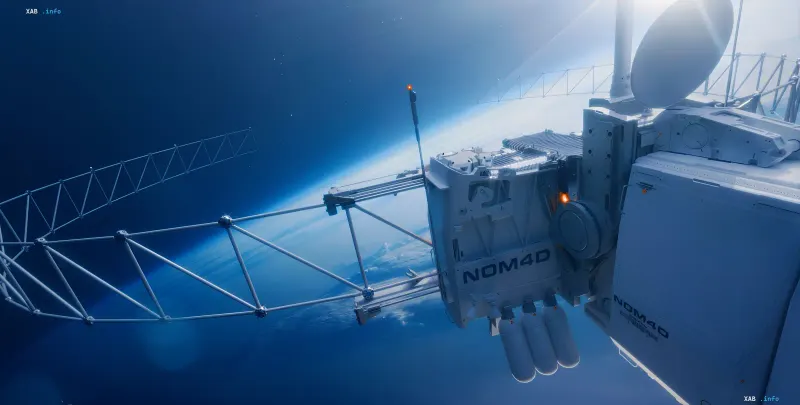
A team from the California Institute of Technology (Caltech) has conducted the first-ever experiment in the fully autonomous assembly of a structure in open space. The experimental ASTRA module (Autonomous In-Space Tensioned Reflector Assembly) spent several hours in orbit connecting composite tubes, aluminum nodes, and a reflective Kapton film to create a 1.4-meter-diameter antenna. The mission's key difference from previous robotic operations in orbit was that the system autonomously positioned parts and fixed them on a mounting plate without requiring direct control from Earth operators.
Launch and Orbital Integration
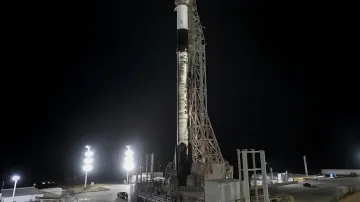
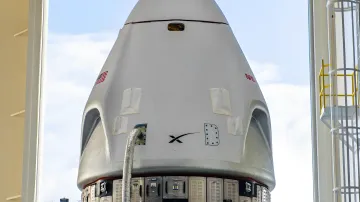
The ASTRA spacecraft launched on March 30, 2026, aboard a Falcon 9 rocket as part of SpaceX's Transporter-16 mission. Upon reaching its target orbit, the module was integrated into the Vigoride 7 space tug developed by Momentus. It was from this platform that the robotic manipulator performed the assembly operations. Control was exercised through brief communication sessions lasting about 15 minutes per day: engineers on Earth transmitted commands, while the onboard system independently handled element positioning and fixture.
DARPA NOM4D Program and Experiment Goals
The demonstration is part of the NOM4D (Novel Orbital and Moon Manufacturing, Materials, and Mass-efficient Design) program by the Defense Advanced Research Projects Agency (DARPA). Project leader Sergio Pellegrino emphasized that the current result merely tests basic assembly algorithms before moving on to large-scale structures hundreds of meters or kilometers in size. According to him, successful autonomous assembly forms the technical foundation for future orbital infrastructure.
Overcoming Launch Vehicle Limitations
Payload limitations during launch are dictated by the dimensions of the rocket fairing: the larger the structure, the more complex and expensive its delivery to orbit. Assembling components in zero gravity makes it possible to create structures of virtually any area, removing dependence on carrier dimensions. This paves the way for creating large optical mirrors for astronomical observatories, powerful solar arrays for orbital power plants, and radio telescopes to receive weak signals from the depths of the universe.
Parallel Research and Mission Limitations
In parallel, under the same DARPA program, a team from the University of Illinois Urbana-Champaign is testing carbon tube hardening methods in open space conditions aboard the International Space Station. As for the ASTRA mission, the team did not manage to complete the full assembly of the antenna due to the strict time limits of the experiment. Nevertheless, the mission confirmed the operability of key autonomous construction stages, which developers consider sufficient to continue scaling the technology.
Prospects for Orbital Infrastructure
The successful demonstration of autonomous assembly in space establishes the basis for the development of global telecommunication networks and scientific research requiring large orbital structures. The technology makes it possible to shift from the 'launch-and-receive' principle to a 'launch components-assemble in orbit' model, which fundamentally changes the economics of space missions and expands the range of feasible projects beyond the capabilities of existing launch vehicles.