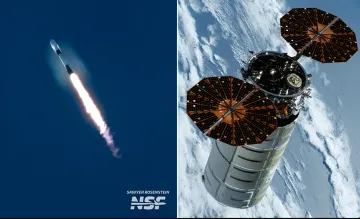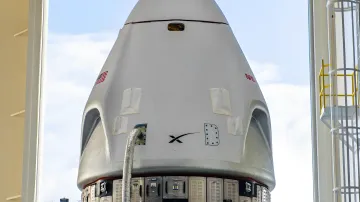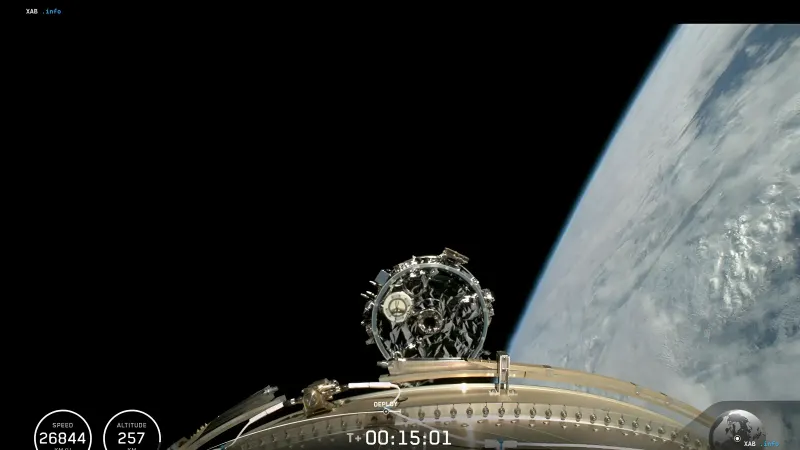
On November 29, 2026, SpaceX successfully launched the Cygnus NG-25 cargo spacecraft into near-Earth orbit. The Falcon 9 launch vehicle lifted off at 10:47 AM EST from Space Launch Complex 40 (SLC-40) at Cape Canaveral Space Force Station in Florida. The spacecraft reached its target orbit and initiated maneuvers toward the International Space Station. This mission marks the 25th flight of a Cygnus spacecraft under the ISS resupply program and the fourth launch of the upgraded Cygnus XL version.
Upgraded Cargo Ship Version
The key feature of this flight is the use of the Cygnus XL variant, which is capable of delivering approximately 30% more cargo compared to the previous spacecraft modification. On board the vehicle are about five tons of equipment, supplies, and scientific experiments for the orbital laboratory crew. Thus, SpaceX continues to increase the payload capacity of its commercial cargo vehicles servicing the station under contract with NASA.
Spacecraft Name and Scientific Cargo
The cargo vessel was named S.S. James «Jim» A. Lovell in honor of American astronaut James Lovell, who commanded the Apollo 13 lunar mission and flew into space three other times. Among the scientific equipment on board are experiments related to developing drug delivery methods for cancer and osteoarthritis treatment, predicting tumor spread, combating muscle mass loss in microgravity conditions, improving radiation sensors, and food production technologies for long-duration space missions.
Docking and Station Operations
Docking of Cygnus NG-25 with the ISS is scheduled for December 1, 2026. NASA astronauts Jessica Watkins and Luke Delaney are expected to capture the spacecraft using the Canadarm2 robotic arm, after which it will be installed on the Earth-facing port of the Unity module. Unloading of the delivered supplies and equipment will begin after the spacecraft is secured to the station. Cygnus will remain docked until May 2027.
Return and Falcon 9 Booster Reuse
Before the mission concludes, the spacecraft will be loaded with several tons of waste, after which it will be deorbited and burn up in the dense layers of Earth's atmosphere. Unlike SpaceX's Cargo Dragon, which returns to Earth and splashes down in the ocean, Cygnus is not designed for reuse—it is a one-way trip. Meanwhile, the first-stage booster of the Falcon 9 with the serial number B1096, used for the ninth time, successfully landed at Landing Zone 40 (LZ-40) at Cape Canaveral after separation, allowing SpaceX to reuse the booster and complete the launch without losing the first stage.
Context: Following the Russian Progress Mission
The launch of Cygnus NG-25 took place against the backdrop of a recent Russian mission: the Progress MS-36 cargo ship carrying the Teledroid device was sent to the ISS from the Baikonur Cosmodrome on November 24, 2026. Thus, both sides—NASA and Roscosmos—continue regular resupply of the station, while the American commercial cargo fleet remains the primary channel for delivering large scientific and material cargo.