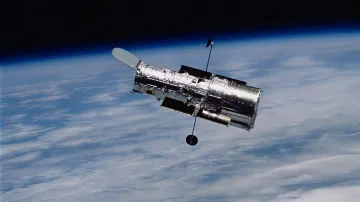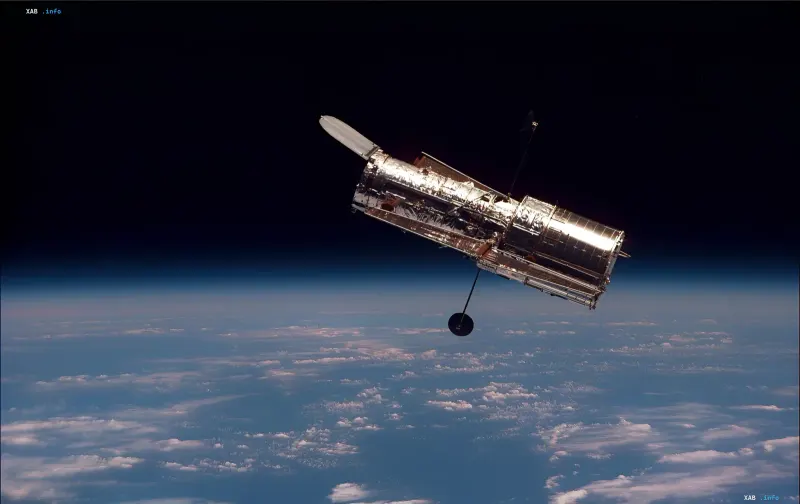
NASA has announced a Request for Information (RFI) from private contractors aimed at extending the life of the Hubble Space Telescope. Launched into orbit in 1990 as a joint project between NASA and the European Space Agency (ESA), the spacecraft is not equipped with its own propulsion system, meaning its orbit is gradually decaying due to drag from Earth's upper atmosphere. Companies can submit their proposals until November 30, 2026, and the mission format can either combine multiple approaches or represent a standalone solution.
Three Rescue Scenarios
The agency has outlined three main directions. First, orbit raising: creating and launching a spacecraft that will capture Hubble and boost it by at least 600 kilometers. Second, in-space servicing: a mission to repair and upgrade onboard systems and scientific instruments to keep the telescope operating in orbit. Third, controlled descent: a safe and controlled atmospheric entry of the observatory after its operations conclude. According to NASA, the rescue mission must take place before 2032.
Timeline and Risks
If intervention does not occur in the coming years, Hubble could re-enter Earth's atmosphere and burn up during a rapid descent approximately in 2033 or 2034. The observatory was last serviced in orbit by a space shuttle in 2009, and currently neither NASA nor ESA possesses a spacecraft capable of lifting the apparatus higher. NASA Administrator Jared Isaacman previously stated that Hubble still has important scientific objectives to fulfill, and continuing its operations will yield more discoveries and opportunities to study the universe.
Previous Attempts
Interestingly, back in 2022, Isaacman—acting as a private astronaut and entrepreneur—along with SpaceX under the Polaris program explored the idea of raising Hubble's orbit using a Crew Dragon spacecraft. At the time, NASA agreed to evaluate the feasibility of the idea, but the flight never took place. Now, the agency has handed the task over to the private sector by opening a broad call for projects.
Why Hubble Is Irreplaceable
Over more than 30 years of operation, the telescope has gathered more than 1.7 million observations referenced in over 23,000 scientific papers. Despite the advent of newer and more powerful observatories, notably the James Webb Space Telescope, Hubble retains capabilities that its successor lacks: primarily observations in the ultraviolet and visible light spectra. The apparatus is still able to study distant galaxies, star formation, and the atmospheres of planets around other stars.
The Cost of Inaction
NASA emphasizes that if the telescope is allowed to burn up in the atmosphere prematurely, science will lose an instrument whose capabilities cannot be replaced for several decades. This is why the agency is betting on the private sector, expecting commercial technologies to provide either orbit raising, modernization, or at least controlled disposal of one of the chief icons of astronautics.