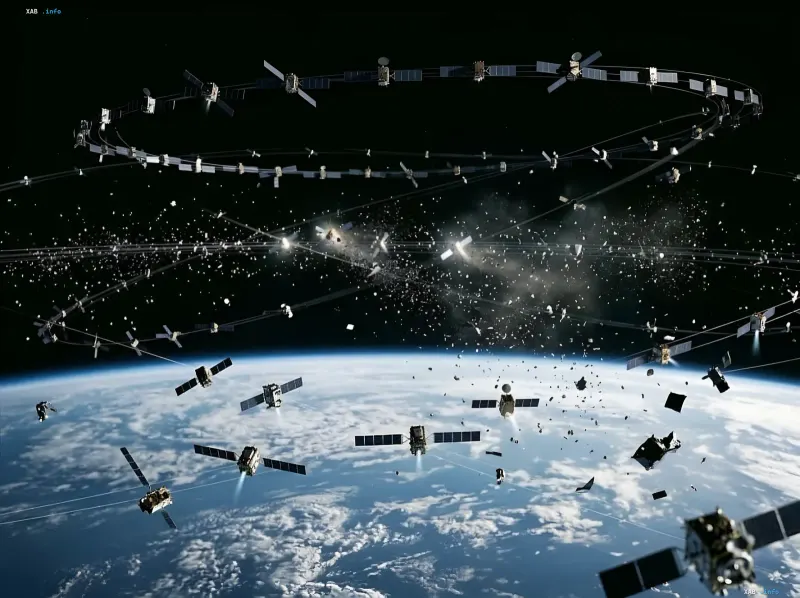
On August 16, 2026, humanity stands on the brink of a critical point in space exploration. According to the latest data, the number of satellites in Low Earth Orbit (LEO) has reached a worrying 30,000 units, and regulators have already received applications to launch over a million more devices. Experts warn: we are approaching a threshold beyond which orbital space will become unusable due to an uncontrolled cascade of space debris.
The Kessler Syndrome: when debris breeds debris
A new scientific analysis conducted by Hugh Lewis from the University of Birmingham has identified a critical size for satellite constellations. After crossing this threshold, orbital collisions trigger a self-sustaining and unstoppable flow of debris — a phenomenon known as the Kessler Syndrome. If all planned projects are implemented, the total number of devices will approach 1.7 million, making low orbits effectively impassable.
The mathematical model of catastrophe
Lewis developed a special mathematical model calculating the frequency of satellites and debris passing through specific areas of the orbit. The model accounts for the ability of devices to maneuver to avoid collisions and their rate of deorbiting after the end of their operational life. The scientist evaluated 16 major satellite constellations already in orbit or in the planning stage and concluded that current growth rates are unsustainable.
Contradictory data
There is disagreement regarding the assessment of the critical threshold. On one hand, some experts believe that even constellations with a few hundred satellites could become unstable due to orbital placement specifics. On the other hand, representatives of space corporations claim that modern avoidance systems and rapid deorbiting technologies allow for safe operation even with high traffic density. However, the lack of maneuvering engines on many devices exacerbates the situation, making them vulnerable to collisions.
Solutions: simple changes with a global effect
According to the scientist's calculations, risks can be significantly reduced through relatively simple design changes. Specifically, the aerodynamic drag of devices can be increased so that they deorbit faster after completing their mission, or the number of new replacements can be reduced by extending their service life. These measures could slow down debris accumulation and prevent cascading collisions.
The future of space operations
If measures are not taken in the coming years, space debris could become a serious threat not only to satellites but also to manned missions. Geostationary orbit, where expensive telecommunications and meteorological satellites are located, is also at risk. Scientists are calling on the international community to urgently review regulations for launching satellites into orbit and to implement mandatory standards for the disposal of space equipment.