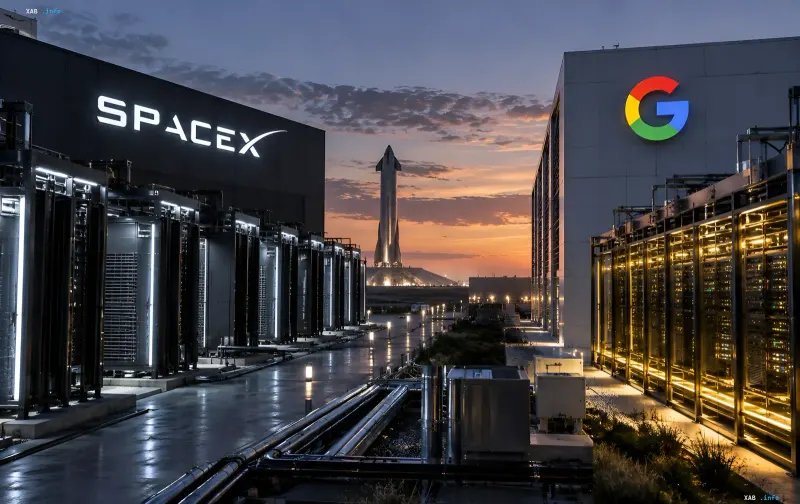
SpaceX CEO Elon Musk stated in the company's third-quarter 2026 report that by the end of 2027, SpaceX is capable of bringing its total AI infrastructure capacity to around 13 gigawatts. According to him, the company plans to add approximately 10 GW of computing power for artificial intelligence throughout 2027. The statement came amid SpaceX's accelerated expansion into the AI segment after it integrated xAI — a developer of large language models and computing clusters — into its corporate structure in February 2026.
Speed That Analysts Compare to Google's 27-Year Track Record
According to analysts' estimates, within 18 months SpaceX could build a volume of data centers comparable to what Google accumulated from 1999 to 2026. Analysts call this goal realistic: to date, they have already identified over 9 GW of potential capacity across various company sites. Thus, the targeted 13 GW by the end of 2027 requires not so much "from scratch" construction as the fine-tuning and launching of already designated locations.
xAI Integration and $40 Billion for Graphics Processors
Expansion accelerated following the integration of xAI in February 2026, which provided SpaceX with both consumer AI workloads and expertise in building computing clusters. To procure graphics processors, the company raised $40 billion in financing. Furthermore, SpaceX can leverage Tesla's manufacturing capabilities to produce ready-made electrical and mechanical data center infrastructure, reducing dependence on external contractors.
Power and Cooling: The New Bottleneck of the AI Industry
Analysts emphasize that the main obstacle for the AI industry right now is not a chip shortage, but a lack of electricity and cooling systems. This is why SpaceX is applying its own engineering expertise gained in rocketry and energy to solve heat dissipation and power supply challenges. This positions the company as a player that builds not only computing power, but also the accompanying energy infrastructure.
Local Conflicts and a Caveat Regarding the 13 GW Figure
Despite rapid construction rates, there are no guarantees of repeating success at all planned locations. The use of gas turbines caused discontent among residents near the data centers: authorities ordered SpaceX to decommission the last temporary gas turbines in Southaven, Mississippi, by July 2027. It is also important to consider that the 13 GW figure denotes power capacity, not actual computing performance. The final outcome in competition with Google will depend on installed equipment and efficiency in handling various AI tasks.
Orbital AI Centers and the Ultimate Test of 2027
Apart from ground-based data centers, SpaceX also plans to deploy AI centers in orbit, which could eventually remove some land and power supply constraints. However, the company's immediate test will be its ability to maintain current construction and power supply rates on Earth throughout 2027. Maintaining this rhythm, rather than the stated figure, will determine whether the 13 GW plan turns into working infrastructure.