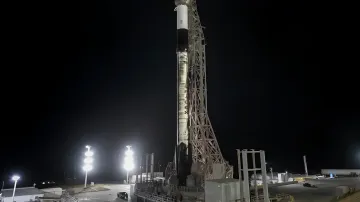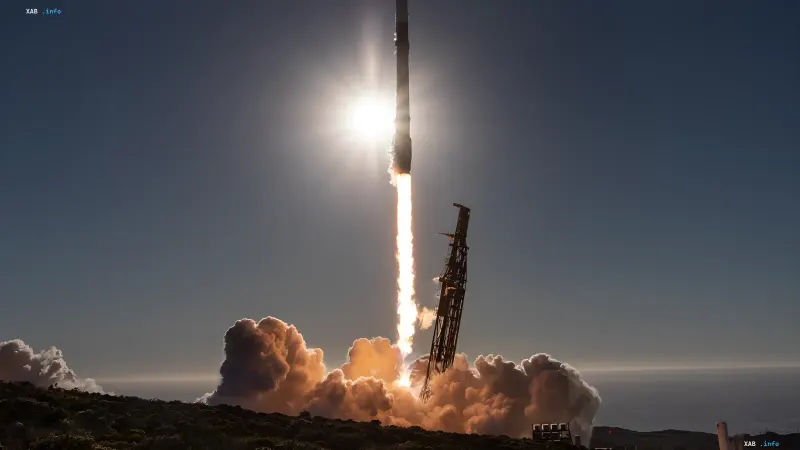
On October 17, 2026, a SpaceX Falcon 9 rocket lifted off from Space Launch Complex 4 East (SLC-4E) at Vandenberg Space Force Base in California. The launch was carried out as part of the USSF-481 mission, deploying a payload into orbit. As is customary for such operations, details regarding the nature of the cargo and the mission objectives are not publicly disclosed—the USSF designation indicates that the task belongs to the U.S. Space Force program, which traditionally involves a classified payload.
Secret USSF-481 Mission
A key feature of the launch was its classified nature. Neither the payload composition, specific orbit parameters, nor the functional purpose of the spacecraft are provided in open sources. This aligns with SpaceX's standard practice when executing defense and space contracts, where USSF mission details are published only post-facto or not at all. For space observers, this launch confirms a steady flow of commercial and government missions conducted from the U.S. West Coast, which is oriented toward launching spacecraft into sun-synchronous and high-inclination orbits.
Workhorse Booster: The First Stage's 28th Flight
For the Falcon 9 first stage, this flight marked its 28th, making it one of the most flight-proven boosters in the company's fleet. Previously, this exact vehicle was used to launch the Crew-7 crewed mission and the CRS-29 cargo mission, deploy the PACE and EarthCARE scientific satellites, as well as support the Transporter-10 and Transporter-13, NROL-186, and NROL-48 programs, among other launches. Additionally, the booster has 16 Starlink satellite deployment missions under its belt. Such intensive, repeated operation of the same booster is a direct result of the reuse strategy, which significantly reduces the cost of each launch.
Controlled Landing on an Autonomous Drone Ship
Following stage separation, the booster performed a controlled landing on the autonomous droneship Of Course I Still Love You (OCISLY), located in the Pacific Ocean. The successful landing on the drone ship confirms the reliability of the recovery and refurbishment system: after landing and maintenance, the stage returns to the active fleet once again. This exact scheme—launch, orbit, recovery, and reuse—forms the foundation of SpaceX's economic model and distinguishes its launch vehicles from previous-generation expendable rockets.
Significance of the Launch for the Industry
The USSF-481 launch with the 28th flight of the first stage once again demonstrates the maturity of reusability technology: a booster that has completed dozens of missions with various types of payloads—from crewed spacecraft to scientific instruments and communication satellite constellations—continues to remain in service. For the industry, this means that reuse has ceased to be an experiment and has become a routine operation that defines competitiveness in the orbital launch market. The next stage for this booster will be preparation and likely its 29th flight after undergoing standard maintenance procedures.