In November 2026, a study appeared on the bioXriv preprint server that is already being called one of the most significant achievements in synthetic biology in recent years. A team of scientists led by Kate Adamala from the University of Minnesota and Drew Endy from Stanford presented SpudCell, an artificial cell capable not only of synthesizing proteins, but also of replicating its own DNA and dividing to form new cellular structures. The development, as the authors note, required several years of continuous experiments and became the result of a multiple redesign of the system architecture.
Architecture of the minimal cell: 36 genes and a lipid envelope
In terms of design, SpudCell is an envelope of fatty (lipid) molecules containing an aqueous environment with a set of 36 genes and specialized proteins. It is this minimal genetic apparatus that allows the cell to perform the basic functions characteristic of living systems: transcription, translation, and replication. At the same time, the genome is not a single linear DNA molecule, but is divided into seven circular segments called plasmids, which is a significant simplification compared to the genomic structures of natural organisms.
Division and replication: the main achievement and its limitations
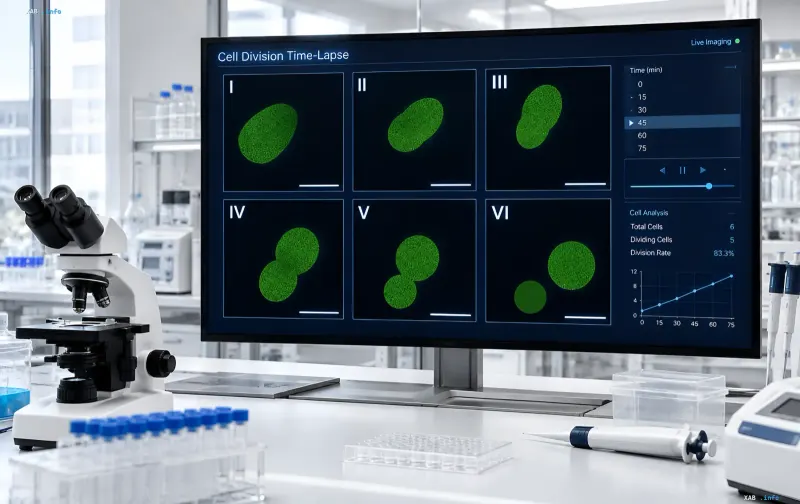
A key breakthrough emphasized by the authors is that SpudCell is capable of independent division and transmission of genetic material to daughter cells. However, the researchers honestly note that the replication process is far from ideal: the cells cannot independently produce ribosomes and require constant nutritional support from the outside. In addition, SpudCell lacks stability — it undergoes only a few division cycles before the process stops. This is precisely why Kate Adamala herself does not yet consider her development to be a fully living organism.
The Biotic initiative: the path to 2050
To accelerate the development of this field, Adamala and Endy launched the Biotic initiative, an open platform designed to unite the efforts of researchers from different countries and laboratories. The strategic goal of the project is to achieve global changes in biotechnology by 2050 based on minimal artificial cells. The authors expect that the standardization of approaches and data sharing between laboratories will shorten the time from fundamental experiment to applied use.
Safety and ethical boundaries: where the non-living ends
The project authors pay close attention to biosafety issues. The description of the system explicitly states that new technologies are initially designed with built-in defense mechanisms, failsafes, and so-called "kill switches" that allow stopping the cell's operation and eliminating unpredictable risks to the ecosystem. At the same time, a discussion continues in the scientific community about whether such laboratory constructs can be considered living organisms: SpudCell demonstrates a number of signs of life, but lacks the autonomy and long-term stability usually embedded in the definition of living. According to experts, this question will determine not only the further development of synthetic biology, but also the formation of a regulatory framework for working with artificial cellular systems.