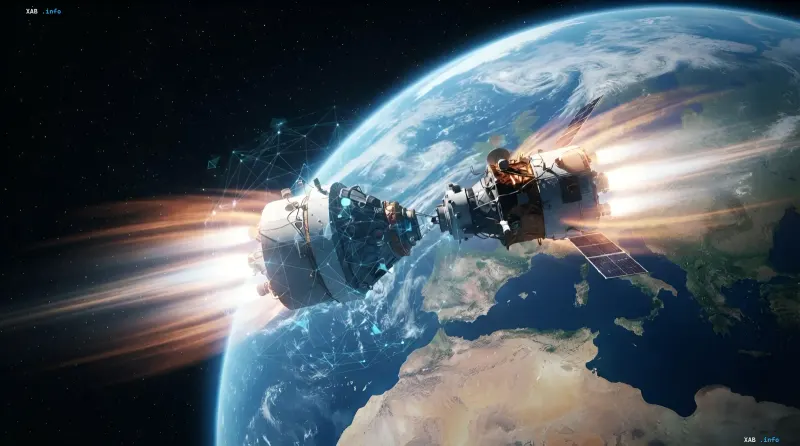
Stanford University researchers have unveiled a revolutionary development in space technology—a new artificial intelligence system designed for fully autonomous spacecraft rendezvous and docking. Amid the rapid growth of astronautics and the increasing number of objects in orbit, the task of safe maneuvering at high speeds is becoming critically important. The new algorithm aims to replace rigid programmed rules with a flexible approach capable of modeling the real physics of outer space.
The Revolutionary OWM Model and Its Capabilities
The new system is officially named the Out-of-this-World Model (OWM). Its key function is to help spacecraft automatically find each other and dock in orbit, where objects move at a colossal speed of about 28,000 kilometers per hour. At such speeds, any minor computational error or sensor glitch can lead to a catastrophic collision and the generation of thousands of dangerous debris fragments. Unlike traditional methods relying on static mathematical calculations and GPS signals, OWM independently forms a dynamic model of the surrounding environment.
Modern orbital systems often face serious obstacles when processing visual data. Sun glares, deep space shadows, and rapidly changing lighting can significantly reduce the accuracy of traditional computer vision, disorienting onboard computers. The Stanford development overcomes these limitations through a deep understanding of physical processes. The artificial intelligence does not merely passively analyze the current camera frame; it continuously simulates dozens of possible future scenarios, evaluates risks, and selects the safest maneuver.
Testing, Results, and Prospects
During large-scale tests, the neural network was trained on hundreds of thousands of virtual space flights, completing about 500,000 training iterations. In simulations mimicking operations with various docking ports of the International Space Station, the OWM system demonstrated impressive results. It successfully completed the complex docking procedure in approximately 53% of cases, while standard AI algorithms handled the same task in only 29% of situations. Particularly high performance was recorded under abnormal conditions, such as when the target docking port was blocked by another spacecraft.
Contradictory Data
Despite impressive successes in virtual simulations, the expert community and the developers themselves note a significant gap between laboratory tests and real-world practice. On one hand, demonstrating a 53% success rate in a virtual environment highlights the immense potential of adaptive AI in non-standard situations. On the other hand, critics point out that the technology is still far from practical deployment on active spacecraft. The most vulnerable phase remains the final approach at minimal distances, where the cost of error is maximal and simulators cannot fully account for all space environment factors.
Nevertheless, the prospects for implementing such technologies in the future are rated very high. Researchers are convinced that after further refinement, field testing, and multi-level verification, OWM-class algorithms will find wide practical application. They will be in demand for automatic orbital satellite maintenance, safe towing to new orbits, and controlled deorbiting of decommissioned spacecraft.