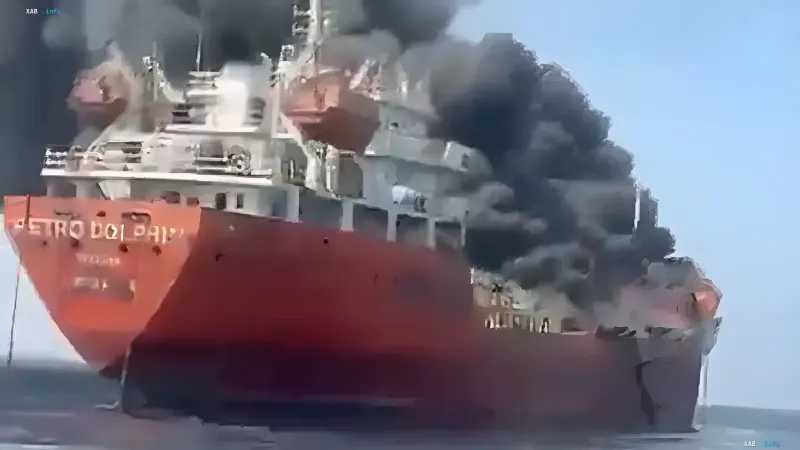
In the Strait of Hormuz, the world's main oil artery, the situation is taking an extremely dangerous turn. On Saturday morning, October 17, another supertanker attempting to pass through the strait without coordination with Tehran and with its transponder turned off hit a sea mine and blew up. Footage released in connection with the incident shows a burning vessel with thick black smoke rising above the superstructure.
Second Explosion in a Day
According to official information from the press service of the Islamic Revolutionary Guard Corps (IRGC), the large vessel was carrying more than 2 million barrels of oil. The tanker sustained damage following an explosion that occurred on the morning of October 17; data on casualties and the vessel's flag state have not yet been disclosed.
Night Fire on Another Vessel
Just a few hours earlier, on the night of October 17, an explosion and severe fire were recorded on another supertanker in the Strait of Hormuz carrying a similar volume — about 2 million barrels of crude oil. It is reported that both vessels were attempting to cross the dangerous zone without official permission, having turned off their satellite tracking systems.
Cause: Restricted Navigation Zone
These incidents are a direct consequence of the protracted military-political confrontation in the region. In September, the IRGC officially announced the introduction of a special restricted navigation zone in the eastern part of the Strait of Hormuz and stated that all merchant vessels must pass through this area exclusively in coordination with Tehran.
Background of Unresolved Conflict
The strikes delivered by the US and Israel against targets in Iran on February 28 of this year, as well as Tehran's retaliatory attacks, created a new flashpoint of war in the region. Although a memorandum on the cessation of hostilities was signed in June, the parties subsequently exchanged strikes again, and the conflict remains unresolved.
Risks to Global Oil Prices
Considering that a significant portion of global oil exports is transported through the Strait of Hormuz, putting two large vessels out of action within a day could lead to a sharp surge in prices for "black gold" on global exchanges.