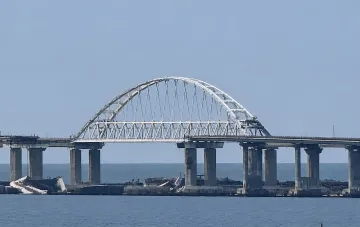
Strikes on bridges are not merely the destruction of individual structures; they are a way to wage war against the very system that enables an army to fight: railways, river crossings, supply depots, and transportation hubs. In the current conflict between Russia and Ukraine, this logic is particularly evident. Ukraine attempts to hinder the supply of Russian troops in Crimea and the occupied south, while Russia strikes bridges across the Dnieper and other transport infrastructure in territories controlled by Kyiv. Essentially, both sides are not attacking soldiers on the front line, but the enemy's "circulatory system," without which the front cannot hold positions or receive reinforcements.
War against logistics, not just troops
The key significance of such strikes is that they target supply infrastructure. A bridge, a river crossing, or a hub is a node through which fuel, ammunition, equipment, and reinforcements flow. If it is destroyed, the enemy is forced to seek detours, which are usually longer, slower, and more vulnerable. This is precisely why analysts emphasize that the goal is not to "break a bridge for the sake of it," but to slow down and disrupt the supply chain of the front. According to an Institute for the Study of War assessment cited by RFI, missile strikes on bridges linking Crimea to the mainland are viewed as part of a campaign aimed at setting conditions for counteroffensive operations.
Why bridges are so difficult to protect
A bridge is, by its nature, a vulnerable target. It cannot be "spread out" across the territory: it has a fixed, predictable position visible from the air and water, and it cannot be quickly relocated. Air defense can protect a specific sector, but a crossing over a large water barrier is a chokepoint known to the enemy in advance. Add to this that bridges are often located far from the front, deep in the rear, where the density of air defense is lower, and it becomes clear why their protection requires enormous resources and remains problematic.
Different tasks of the same strikes
It is important not to assign the same significance to every destroyed bridge. Strikes on crossings have several different military tasks: from a direct disruption of supply to a specific section of the front, to forcing the enemy to redistribute reserves and manpower for repairs. And not every destroyed bridge means the enemy is cut off from supplies—often, there are backup crossings, pontoon bridges, or detour roads that compensate for the loss. Therefore, assessing the effect of a specific strike requires knowing how critical that particular crossing was for the logistical scheme of the front at that moment.
Can bridges change the course of the war
Bridges themselves rarely determine the outcome of a battle instantly, but combined with other infrastructure strikes, they can change the dynamics of the conflict: slowing down an offensive, complicating defense, and increasing the price of every kilometer of progress. If strikes on crossings systematically complicate the supply of a particular direction, this creates conditions for counteroffensive operations or, conversely, forces a side to retreat. Thus, the war for bridges is a slow but strategic tool: it does not provide one "decisive" shot, but gradually reshapes where and how the enemy can conduct military operations.