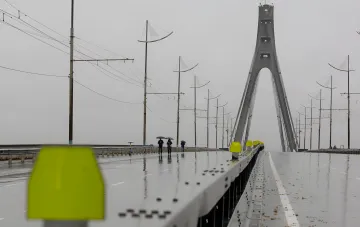
In the RBC-Ukraine podcast "ETSE BAZA" (This is the Base), the head of the Desnianskyi District State Administration, Maksym Bakhmatov, detailed how Kyiv is coping with the aftermath of strikes on the Northern and Southern bridges and what will happen if vehicle crossings over the Dnieper cease functioning entirely. According to him, after another missile hit, he personally contacted Mayor Vitali Klitschko to propose several traffic organization solutions, but was told: "Maksym Isanovych, this is not your area of responsibility, stay out of it." Nevertheless, Bakhmatov gathered responsible officials and streamlined public transport logistics from the left bank to the right: the journey now takes about 15–18 minutes instead of one and a half to two hours, and bus route No. 114 can reach Podil faster than it did before the bridge strikes.
Pontoon crossings will only provide minimal transit
The only currently feasible solution, according to Bakhmatov, is pontoon crossings, which have already begun construction and are expected to be completed within two to three months. However, they will only provide minimal transit for critical vehicles. The district administration head dismissed ideas of ferry and river alternatives as unviable: a single river shuttle carries 60–70 people, whereas a million people need to move between the banks. By his calculations, ferries can cover about 3% of needs, crossings about 10%, and even combined they do not reach 100% of the bridges' throughput capacity. Moreover, according to Bakhmatov, access routes to the pontoon crossings should have been built in advance, which was not done.
Tunnel under the Dnieper: skepticism regarding timelines
The Ministry of Infrastructure announced the construction of a tunnel under the Dnieper, but Bakhmatov expressed doubt about its feasibility, pointing to lengthy planning, financing, land approval, and security guarantee stages. Member of Parliament Serhiy Nahornyak stated that the first car would be able to drive through the tunnel no earlier than 2036. At the same time, the government has already approved a project for alternative crossings with a projected launch in 2027; Bakhmatov ironically promised to "drink champagne" in 2027 if it actually works. He also recalled that a tunnel project under Kyiv to Peremohy Square (now Halytska Square) existed back in Soviet times, and the Podil bridge crossing, into which significant funds have been invested, runs into transport bottlenecks and constant traffic jams.
Heating and water: vulnerability of the left bank
Bakhmatov's key warning was an assessment of life-support risks: if strikes on the power grid continue, Kyiv's left bank could face serious heating and water supply problems, and pontoon crossings and river transport will not be able to fully replace the destroyed bridges. This vulnerability is already manifesting in practice: according to city administration and Mayor Vitali Klitschko, outages and pressure drops in the water supply network were recorded on Kyiv's right bank amid power supply issues when pumping stations were partially de-energized and electric transport stopped. Energy workers, according to authorities, are working to restore water supply.
Personal plan and scale of the task
Answering a question about his own contingency plan in case of a complete blockade of the crossings, Bakhmatov admitted that since 2022 he has kept a personal plan to reach his mother, who lives on the left bank: the route through Kaniv and Cherkasy would take three to four hours one way, but there may be no alternative. His statements underscore that none of the options discussed — crossings, ferries, or a tunnel — fully solve the problem, and Kyiv, he says, needs not just one, but a system of alternative crossings, which currently does not exist.