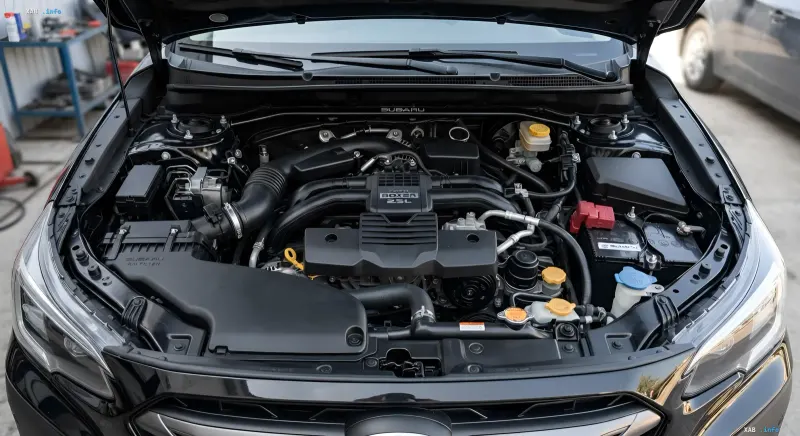
Japan's Subaru has confirmed work on a fundamentally new generation of four-cylinder boxer internal combustion engines, setting one of the most ambitious goals in the modern automotive industry — achieving a thermal efficiency (efficiency rate) of 50%. This is reported by the Japanese resource MotorFan, citing data from the company's internal developments. For comparison, most mass-market gasoline engines today operate with an efficiency of 35–40%, while advanced diesel units rarely exceed 45%. Thus, Subaru's claimed benchmark of 50% would mean not just an evolutionary step, but a qualitative leap in the efficiency of converting fuel chemical energy into mechanical work.
Intra-Cylinder Aerodynamics: Where Efficiency Is Born
A key area of work for engineers has been improving air flow dynamics inside the cylinders. The goal is to ensure the most uniform mixing of fuel and air before ignition, which directly affects combustion completeness and, consequently, thermal efficiency. To optimize this process, Subaru actively uses 3D combustion modeling, which allows predicting flame propagation in the cylinder and pre-evaluating the risk of detonation. Preliminary studies have confirmed that air movement in the cylinders of the new engine has become significantly more intensive, creating the foundation for more controlled and complete mixture combustion.
First Tests: Twice as Wide a "Green Zone"
Initial bench tests have already yielded encouraging results. According to MotorFan, the range of operating modes in which the engine demonstrates high thermal efficiency turned out to be approximately twice as wide as that of the naturally aspirated motor used in Subaru's current hybrid model. This means the new unit will maintain high efficiency not only in a narrow "ideal" mode, but across a wide spectrum of everyday loads — from city traffic driving to highway acceleration. The engine under development will feature direct fuel injection and turbocharging, allowing precise control over air supply and maintaining high torque across a wide rpm range.
Variable Geometry Turbo, Electric Boost, and the Miller Cycle
Among the additional engineering solutions considered for the new boxer are several technologies. First, a variable geometry turbocharger, which allows flexibly adapting boost pressure to the current operating mode. Second, electric boost support, known as e-boost, which eliminates turbo lag and provides an instant response to gas pedal inputs. Third, the Miller cycle, involving altered intake valve timing: early closing of the intake valve reduces the effective cylinder displacement at intake, increasing combustion efficiency while lowering exhaust gas temperatures and reducing heat rejection losses.
Pre-Chamber Ignition: 50% Unlikely Without It
The most radical and, according to Subaru's own assessment, critical element of the concept is pre-chamber ignition technology. The principle is that a small auxiliary chamber is placed in the cylinder, where a portion of the air-fuel mixture burns first. The resulting high-pressure hot gases then ignite the main charge of fuel within the cylinder's working volume. This achieves faster and more complete combustion at lower temperatures, reducing nitrogen oxide emissions and increasing efficiency. Subaru explicitly admits that achieving the 50% target without pre-chamber ignition will be extremely difficult, highlighting the strategic importance of this technology for the entire program.
Timeline and Context: Where the Boxer Is Heading
The company has not yet announced exact timelines for the appearance of the new engines in production cars. Considering that this is a comprehensive package of innovations — from intake aerodynamics to pre-chamber ignition — experts estimate the realistic horizon for mass production implementation to be a few years away. Nevertheless, the very fact of publicly discussing such parameters indicates that Subaru intends to preserve and strengthen its niche in the boxer engine market, rather than letting them simply "fade out" before a full transition to electric vehicles. Against the background of competitors either abandoning ICEs or limiting themselves to moderate-efficiency hybrid schemes, Subaru's bet on 50% looks like an attempt to prove that the internal combustion engine is still capable of a technological breakthrough.