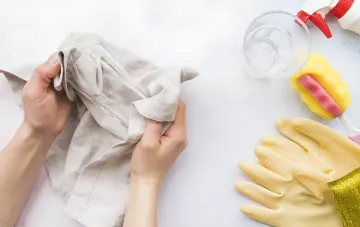
A favorite sweater after a single wash can end up a couple of sizes smaller: the sleeves shorten, the shoulders tighten, and the garment begins to resemble a children's item. Most often, this happens with wool and cashmere, which react acutely to water temperature, friction, and improper drying. We figure out why knitwear shrinks, in which cases it can still be saved, and how to perform restoration without harming the loops.
Why a Sweater Shrinks
The main cause of shrinkage is a combination of moisture, heat, and mechanical action. Under their influence, the scales of the wool fiber open up and cling to each other, causing the fabric to thicken and the garment to lose volume. Additional factors include intensive drum rotation, strong spin cycles, and rough twisting. As clothing manufacturer Fjällräven emphasizes, when caring for wool, it is important to avoid excessive friction and twisting, as well as drying in an inappropriate mode. Temperature deserves special attention: hot water accelerates fiber felting, so you should not soak knitwear in it.
When Restoration Is Possible and When It Isn't
Before taking action, you need to assess the condition of the fabric. If the sweater has remained soft and elastic, and the knitting loops are clearly distinguishable, there is a chance to recover at least part of the lost shape. However, if the fabric has become rigid, thick, and resembles felt, the fibers have already heavily felted, and restoring the original appearance is practically impossible. This limitation applies to any method, including professional ones. Before manipulations, it is worth checking the label: if the manufacturer allows only dry cleaning, soaking the item independently is not recommended.
Step-by-Step Wet Blocking Method
For minor shrinkage, the wet blocking method is suitable. Cool water is poured into a basin, and a small amount of wool detergent is added according to the instructions. The sweater is gently immersed and soaked for about 15–20 minutes without friction or stretching. After that, the item is removed, excess moisture is removed by gently pressing with hands — wringing is strictly prohibited. Then the sweater is placed on a towel, rolled up with it for water extraction, and laid out on a dry surface. The damp fabric is carefully smoothed out, gradually evening out the sleeves, width, and length, and dried horizontally at room temperature, away from radiators and direct sunlight. It is important not to try to stretch the item by several sizes at once: excessive force can damage the loops and deform the seams.
Cashmere and Delicate Fabrics
Cashmere is one of the most delicate natural fibers, requiring especially careful handling. If a cashmere sweater has become slightly smaller but retained its softness, it can be moistened according to the label recommendations, excess water removed with a towel, and laid out on a flat surface. The fabric is smoothed out with hands very carefully, giving it the desired shape, without sharp tugs at the sleeves or lower hem so that the knitwear does not lose symmetry. For expensive or heavily deformed items, it is safer to contact a dry cleaner working with delicate fabrics, although even professional care does not guarantee the recovery of felted fibers.
Home Remedies and the Conditioner Myth
Social media often advises soaking a sweater in water with hair conditioner and then stretching it by hand, believing that the product softens the fibers. There is no convincing evidence of this method's effectiveness: the cosmetic composition can leave a residue on the fabric and does not eliminate severe felting. Home options also mention adding pharmacy glycerin to warm water — according to several publications, it makes the fibers more slippery and soft, facilitating subsequent smoothing. Nevertheless, for valuable items, it is preferable to use special products designed specifically for wool and cashmere care.
What to Do with Different Fabrics
The restoration result depends on the composition and structure of the fabric. In the absence of severe felting, wool sometimes yields to wet blocking, while heavily compacted wool is practically impossible to return to its original state. Cashmere can be gently smoothed when wet, but strong tension can damage the knitwear. Cotton sweaters also shrink, especially at high temperatures, and damp fabric can sometimes be slightly straightened, though complete restoration is not guaranteed. Acrylic and polyester usually retain their shape better with proper washing, so synthetic deformation is more often associated with improper care regimens.
The conclusion is simple: the smaller the shrinkage and the more careful the care, the higher the chance of saving the item. For slight compression, wet blocking with a suitable product and horizontal drying helps; for severe felting, only dry cleaning, and even then without a guarantee. The main rule is not to experiment with hot water and not to pull the fabric by force so as not to turn a beloved item into a permanently ruined one.