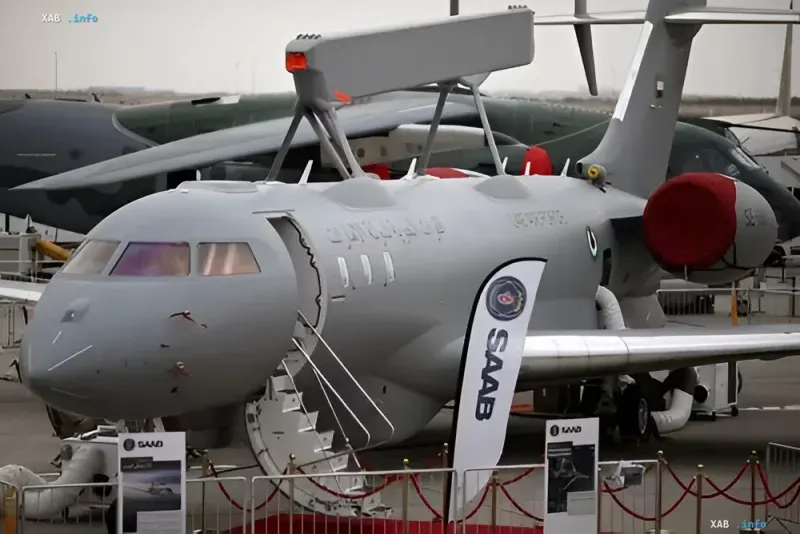
Saab has officially unveiled the first serial GlobalEye airborne early warning and control (AEW&C) aircraft, equipped with a long-range radar system, for the Swedish Air Force. The manufacturer announced this on its corporate website. The machine's presentation marks the project's transition to the flight testing and onboard systems verification phase. The aircraft will soon perform its maiden flight, followed by the final delivery process to the customer, the Swedish Ministry of Defense.
Three machines replacing the aging Saab 340s
The Swedish Air Force expects a total of three GlobalEye aircraft. The contract for the first two units was signed by the government in 2022; the agreement included an option for additional aircraft, which Stockholm exercised in 2024 by ordering a third unit. These new machines will fully replace the obsolete Saab 340 AEW&C system that has been in service with the Swedish Air Force for several decades. Notably, the Saab 340 aircraft have already been transferred to Ukraine, making the switch to the GlobalEye not only a technological upgrade but also a geopolitical move within the framework of European defense redistribution.
Erieye ER radar: +70% detection range
Development of the GlobalEye system began in the 2010s, based on the Bombardier Global 6000 business jet airframe. The core element of the reconnaissance complex is the Erieye ER (Extended Range) active electronically scanned array radar, operating in the S-band. The antenna is housed in a distinctive vertical structure atop the fuselage — an element that makes the GlobalEye visually recognizable in photographs and air show footage. By switching to Gallium Nitride (GaN) technology, developers have increased target detection range by 70% compared to previous Erieye iterations. The radar is capable of detecting aerial targets with a low radar cross-section — cruise missiles, unmanned aerial vehicles — at a distance exceeding 550 kilometers.
Multi-sensor architecture and data integration
Beyond the primary radar, the GlobalEye carries the Leonardo Seaspray multi-mode ground and maritime surveillance radar, mounted under the fuselage, as well as electro-optical and infrared sensors, electronic intelligence (ELINT) equipment, and self-defense suites. The flight deck and operator workstations are connected via a unified onboard network, enabling real-time situational data transfer to ground control centers, warships, and fighter jets. According to Saab, the Bombardier Global 6000 airframe enables over 11 hours of continuous flight endurance without refueling at an operational altitude of 10–11 km, which is critical for long-duration airspace patrol missions.
International program context
Beyond Sweden, the United Arab Emirates is among the primary international customers for the GlobalEye. Thus, the program forms a limited but technologically sophisticated group of operators. For Sweden, the introduction of the GlobalEye fills a multi-year gap in airborne surveillance and control capabilities that emerged following the decommissioning of the Saab 340s and their transfer abroad. In the context of increasing defense budgets across NATO’s Northeastern flank, the ability to detect small aerial targets at ranges over 550 km is becoming a key efficiency criterion for AEW&C systems.