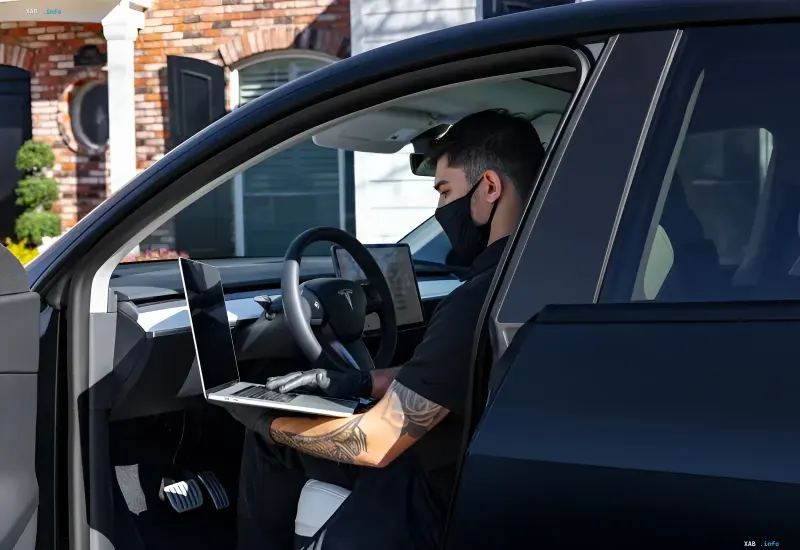
Chinese regulators have imposed new requirements on Tesla that go beyond the already-known door handle campaign. This time, authorities have ordered the company to strengthen monitoring of driver behavior using a camera pointed into the cabin of the electric vehicle. The corresponding software update will affect 2,740,642 Tesla vehicles operating in the PRC. According to local supervisory bodies, previous measures to monitor driver attentiveness proved insufficient, especially when the level-2 driving assistant (per SAE classification) is in use.
Campaign to Strengthen Driver Monitoring
According to the position of Chinese regulators, Tesla must ensure surveillance of the driver's gaze direction so that they do not look away from the road while the level-2 driving assistant is functioning. The entire campaign is being carried out as an over-the-air software update: electric vehicle owners will not need to visit service centers. The recall campaign covers nearly 2.8 million Model 3 and Model Y vehicles produced at Tesla's Shanghai plant between March 2019 and December 7, 2025.
How Tesla Monitored the Steering Wheel Before
Historically, the company relied on a steering wheel sensor that determined whether the wheel encountered characteristic resistance when turned, indicating that the driver's hands were on it. This is how control was maintained over the requirement that the driver's hands remain on the wheel for the majority of the trip. However, as autopilot developed, abuses increased: some companies began openly selling devices that could fool the automation, and videos spread online showing Tesla drivers not holding the wheel and even sitting in the passenger seat.
The History of the Cabin Camera
The cabin-facing camera has been present in the Model 3 since the model's debut in 2017, appeared in the Model Y after the crossover hit the market in 2020, and was added to the higher-end Model S and Model X after their restyling in January 2021. In the US market, the company began actively using this camera to monitor driver condition only in May 2021. It was stated that the camera does not record video of the cabin and is used only to track the driver's eye position. In China, the company began using the cabin camera this year, when the Tesla Assisted Driving system—known as FSD in other markets—became available to local customers.
Fooling the Automation with Mannequins
In China, video reports have already emerged showing that the camera can be "fooled" with a plastic mannequin head. Drivers placed mannequins with a fixed gaze in front of the camera, and some managed to drive in assistant mode without real road monitoring for up to 30 minutes at a time. Before this, Tesla long resisted calls to enable the cabin camera in China, citing the specifics of local legislation. Now the company is forced to use it precisely at the authorities' request—and with more effective algorithms than originally.
Contradictory Data
In the public domain, there are discrepancies in emphasis and interpretation. On the one hand, Tesla previously emphasized that the cabin camera does not record video and is used only to track gaze, while practice in China and regulator requirements point to its actual use for video surveillance of the driver. On the other hand, different outlets characterize the scale and reason for the recall differently: some sources emphasize the door handle issue, others speak of a "record three million" vehicles, and still others focus on the driver surveillance system. According to the main text, the camera campaign covers 2,740,642 vehicles, and including the door handle campaign, the total recall volume in the PRC is 5,716,552 electric vehicles.
Scale of the Recall Campaigns
Thus, including the campaign concerning door handles, Tesla will have to recall a total of 5,716,552 electric vehicles operating within the PRC. This makes the current series of measures one of the largest in the history of the Chinese automotive market and underscores that the regulatory focus is shifting from individual design details to driver monitoring systems and driving assistant safety.