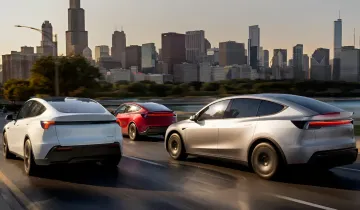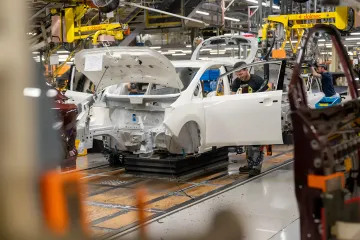
Tesla has announced the achievement of a significant milestone — the production of its 10-millionth electric vehicle. This news was shared via an official post on the social network X. This figure was reached just six years after the first million vehicles were produced, demonstrating the manufacturer's impressive growth dynamics.
Elon Musk's Goals and Compensation Package
Surpassing the 10-million vehicle mark holds strategic significance for CEO Elon Musk. The company is now halfway to achieving one of four key objectives that determine the conditions for Musk's $1 trillion compensation package, which was approved by shareholders last year.
By 2035, Tesla must accomplish the following tasks:
- Ensure the production of 20 million vehicles;
- Build a subscriber base of 10 million for the Full Self-Driving (FSD) system;
- Deliver 1 million robots;
- Deploy 1 million robotaxis on the roads.
Slowing Pace and Search for New Markets
Despite years of intense growth driven by the popularity of the Model 3 and Model Y, the company has faced challenges. Tesla failed to sell 2 million vehicles in the last year. If current trends persist or slow down, the company will need to work at least until the early 2030s to reach the 20-million vehicle goal.
The situation in the domestic US market also raises questions. Although competition from traditional car brands has decreased, and startups like Rivian and Lucid Motors are struggling with scaling, Tesla's sales in the second quarter dropped by 13% year-over-year. In search of buyers, the company is forced to focus on markets in Japan, Australia, and Lithuania.
Realism of Plans and Financial Challenges
Previously, Elon Musk promised that Tesla would produce 20 million vehicles annually by 2030, but later abandoned these plans due to slowing sales. Of the four set goals, the first is currently closest to fulfillment. The FSD audience recently reached 1.5 million subscribers, though it remains unclear whether this figure includes users who chose a free trial period, who are excluded from the count according to official terms.
The development of robots and robotaxis is in its early stages. Another ambitious goal is to increase adjusted profit (EBITDA) to $400 billion by 2035. Currently, this figure stands at approximately $3.27 billion and shows a downward trend due to significant discounts, the loss of regulatory credits, and a sharp rise in expenses for artificial intelligence and robotics projects.
Competition with China
The only player in the world capable of competing with Tesla on a comparable level is the Chinese company BYD. It recently surpassed the 17-million vehicle production mark, with approximately half of these being hybrid models. This places Tesla in a position to accelerate production rates to avoid falling behind its Asian competitor in the race for global leadership.