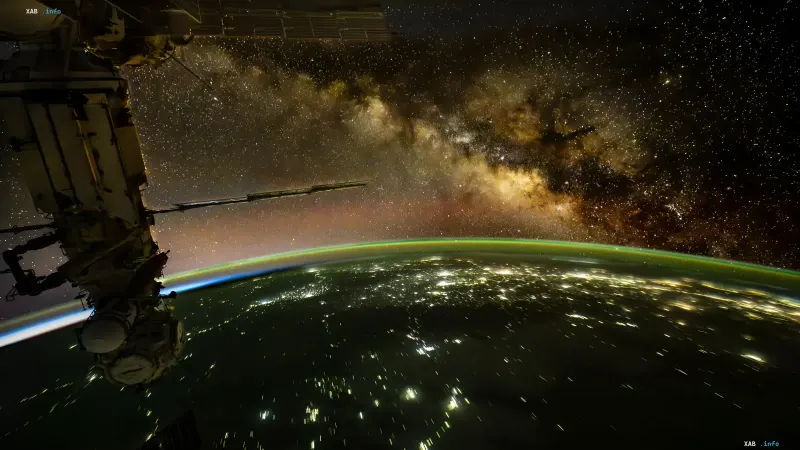
NASA astronaut Don Pettit shared insider details about creating one of the most stunning images of our galaxy, taken from the International Space Station (ISS). The key to success was not just the camera, but a unique engineering modification designed to compensate for the colossal speed of orbital flight.
The Speed Problem: Why Stars Turn into Streaks
Photographing space from orbit is a non-trivial task. The ISS orbits the Earth at a speed of about 17,000 miles per hour (approximately 27,000 km/h). While the station maintains a constant position relative to the planet's surface, this is imperceptible to an observer on Earth but creates a serious problem for a photographer pointing a lens into open space.
During the long exposure required to capture the light of distant stars, a standard camera records not the stars themselves, but their displacement relative to the station. As a result, on standard shots, stars turn into blurred arc-shaped streaks rather than sharp points of light.
The Solution: A Space Tracker
To overcome this physical limitation, Don Pettit adapted the principle of terrestrial star trackers for orbital conditions. He developed a special mechanism that rotated in the direction opposite to the station's orbital motion.
The device's rotation period was synchronized with the ISS's orbital cycle—about 90 minutes. This allowed the camera to remain static relative to the starry sky, even though the station itself was flying forward at high speed. As a result, instead of blur, the sensor captured an image with crystal-clear stars.
Technical Equipment
To implement this project, the astronaut used professional equipment:
- Nikon Z9 camera;
- Arri Zeiss 15mm lens.
The combination of powerful optics and mechanical motion compensation allowed him to capture the Milky Way with incredible detail that would have been impossible to achieve with the station's standard means.
Engineering vs. Physics
This image serves as a vivid proof of how important modern technology and non-standard engineering solutions are in space exploration. The result achieved with what is essentially simple mechanical parts has become one of the most interesting achievements in the history of space astrophotography, opening new possibilities for the visual perception of our Universe.