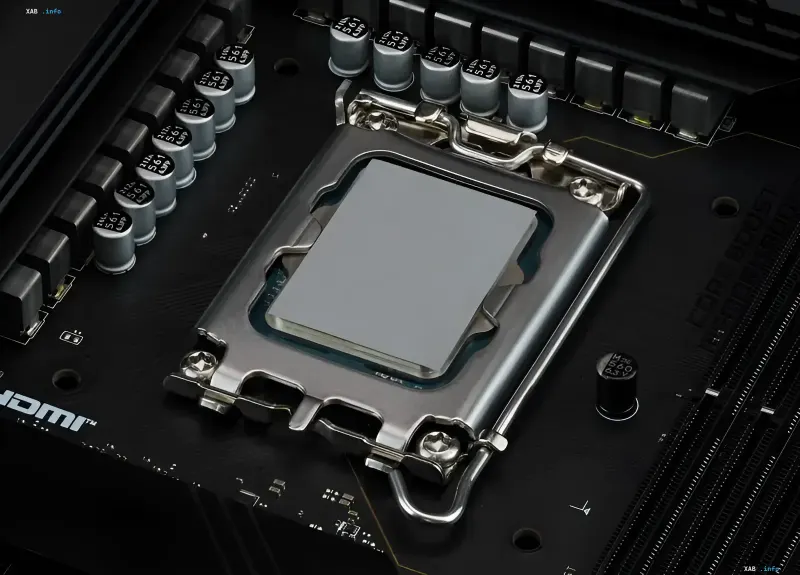
Thermal Grizzly Holding GmbH has announced the release of PhaseSheet PTM Pro, an advanced version of its phase change material (PCM) thermal interface. The new product is positioned as an evolution of the PhaseSheet PTM lineup, featuring an optimized chemical composition that delivers enhanced thermal conductivity compared to its predecessor. Designed primarily for cooling central processors and graphics chips, the material's electrically non-conductive properties also allow for its use in other scenarios requiring reliable thermal contact between a die and a heat dissipation system.
Phase-Change Mechanism: From Solid Sheet to Liquid Coolant
PhaseSheet PTM Pro is a thermally conductive sheet that remains solid at room temperature, simplifying its placement on the chip's contact surface. When heated above 45 °C, the material transitions into a liquid phase with very low viscosity, efficiently dispersing heat on par with traditional thermal pastes. Upon cooling back into a solid state, the material contracts slightly, which the manufacturer states helps maintain a stable contact layer. To ensure optimal distribution of the liquid phase and the formation of the thinnest possible working layer, significant mounting pressure—in the range of 300 to 400 N—is required, which is typical for cooling systems with a massive base and rigid mounting.
Simplified Application Thanks to a New Carrier Film
A key practical improvement of PhaseSheet PTM Pro over the base version is the new protective carrier film. The protective layer is easily peeled off from both sides of the thermal pad, significantly reducing the risk of accidentally tearing the thermal interface during installation. For the end user and system integrator, this means a more predictable and neat installation process without the need to handle a fragile solid material on a "bare" contact.
Combating the Pump-Out Effect and Durability
The cyclic phase-change mechanism allows PhaseSheet PTM Pro to effectively resist the so-called pump-out effect. This issue is particularly pronounced in laptops combining a copper cooler with a silicon graphics die, as copper and silicon have different thermal expansion coefficients. In desktop systems under load, the processor IHS and cooler base may deform slightly, bowing outward or inward, and return to their original shape upon cooling, gradually squeezing conventional thermal paste out of the contact zone. PhaseSheet PTM Pro maintains low viscosity in its liquid state and contracts when solidifying, thereby minimizing this effect. The manufacturer emphasizes the product's high durability and thermal conductivity stability over a long service life.
Specifications, Availability, and Market Context
PhaseSheet PTM Pro in a 40 × 40 mm format is now available to order on the official Thermal Grizzly website for $23.28. By comparison, the base PhaseSheet PTM version released earlier measured 50 × 40 mm and, according to industry publications, reached peak thermal conductivity after approximately ten heating cycles above 60 °C. The new Pro version, judging by its description, retains this "break-in" logic but offers an improved composition and simplified installation. In the thermal interface market, PhaseSheet PTM Pro occupies an intermediate niche between classical pastes and virtually maintenance-free solutions like KryoSheet, offering a balance between ease of use, durability, and thermal conductivity.