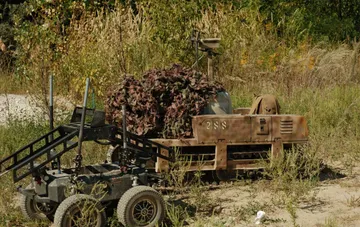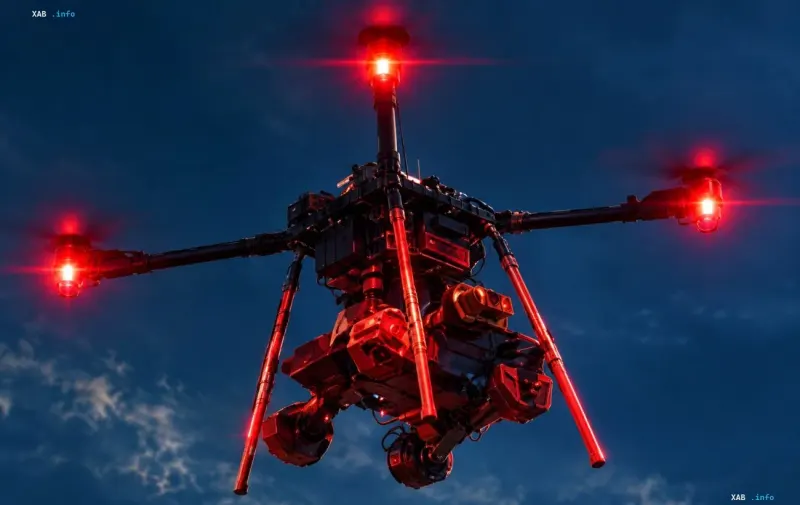
The Third Army Corps of the Armed Forces of Ukraine has become the first in the history of military robotics to employ the tactic of air-dropping ground robotic complexes (GRC) from heavy strike unmanned aerial vehicles (UAVs) bearing the callsign 'Griffin' within the unit. The operation, carried out as part of the 'Vivaldi' campaign in the Donetsk region, enabled the GRC kamikaze units to be dropped more than 10 kilometers deep into the enemy's rear, destroying its logistics hub. This was reported by RBC-Ukraine on September 25, 2026, citing the official Telegram channel of the Third Army Corps.
Chronology of the First Operation: From Failure to Success in a Single Day
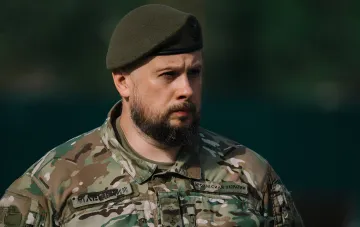
The commander of the strike ground complexes unit NC13, part of the Third Independent Assault Brigade of the Third Army Corps, callsign 'Makar', explained that the first drop attempt was carried out jointly with the brigade's unmanned systems battalion. The pilots delivered two robots to a point 15 kilometers from the front line and dropped them. However, the unit chose an inopportune moment: the enemy detected the movement of the devices and opened fire, destroying both GRC units. On the same day, the soldiers repeated the attempt, dropping two more robots into the same area. The second group reached its target — a staging point where Russian troops stopped to regroup and rest — and destroyed it. According to 'Makar', it was precisely this success that allowed the unit to systematize its approach and move to regular application of the tactic at ranges of up to 15 kilometers deep in the enemy's rear.
The Road to Air-Dropping: From Concept to Combat Use
Conceptually, the unit arrived at the idea of aerial delivery of ground robots back in November 2025, when it reached the level of a strike brigade equipped with GRC. At that time, the commander tasked the in-house engineers with developing a device adapted for transport and drop from a drone. According to 'Makar', the system for dropping GRC from UAVs has been in use by the soldiers for about four to five months. During this period, the unit had to solve a whole range of engineering challenges: determining how to attach the robot to the UAV, studying the device's behavior in the air during the drop, selecting an optimal ammunition loadout, ensuring reliable communications at range, and developing mission-planning algorithms that allow the direction from which the strike is delivered to be concealed from the enemy for longer. Before this, the commander claims, no unit in the world had air-dropped ground robots — let alone done so systematically on the battlefield.
Combat Results and Psychological Impact on the Enemy
According to NC13, the success rate of GRC drop operations is around 80 percent — a result that 'Makar' attributes to tight coordination among all involved links, from the workshop and planning group to the on-duty operators. In addition to direct strikes on positions, the robots are used for 'free hunting' along the enemy's logistics routes: in one operation, a single GRC killed two and wounded four more Russian soldiers. Ground robots were also used to capture prisoners and to hold a position fitted with a machine gun for 45 days. According to the unit's observations, such actions cause panic among the enemy and force Russian command to prohibit movement along certain routes and to place positions on full combat readiness. In one case, the killing of a single soldier by a ground robot led to the cancellation of a planned mechanized assault.
The Callsign 'Griffin': Memory of a Fallen Soldier
The name of the strike UAVs, 'Griffin', is tied to the callsign of NC13 machine gunner Hryhoriy Bah, who went missing in action during the fighting for Andriivka in 2023, when the unit was still an assault platoon within the second assault battalion. According to 'Makar', each operation using the 'Griffins' is a way to honor the fallen comrade and avenge him. The commander of NC13 also appealed to the commanders of other battalions and brigades to develop the field of ground robotic complexes, emphasizing that robotics helps preserve the lives of personnel by taking on tasks involving a high risk of direct casualties, which would otherwise fall to the infantry.
International Context: The Robotization of Ground Combat
The trend toward active development of ground robotic complexes is also observed beyond Ukraine. The Croatian manufacturer Rheinmetall Unmanned Vehicles recently conducted field tests of the heavy GRC MV-8 Komodo, which, among other things, learned to remotely deploy pontoon bridges for the passage of vehicles. During the same tests, an autonomous control package was trialed, allowing the robot to move independently along a set route without constant operator intervention. These developments confirm that aerial delivery and autonomous use of ground robots are becoming one of the key directions in the evolution of close-combat tactics in modern conflicts.