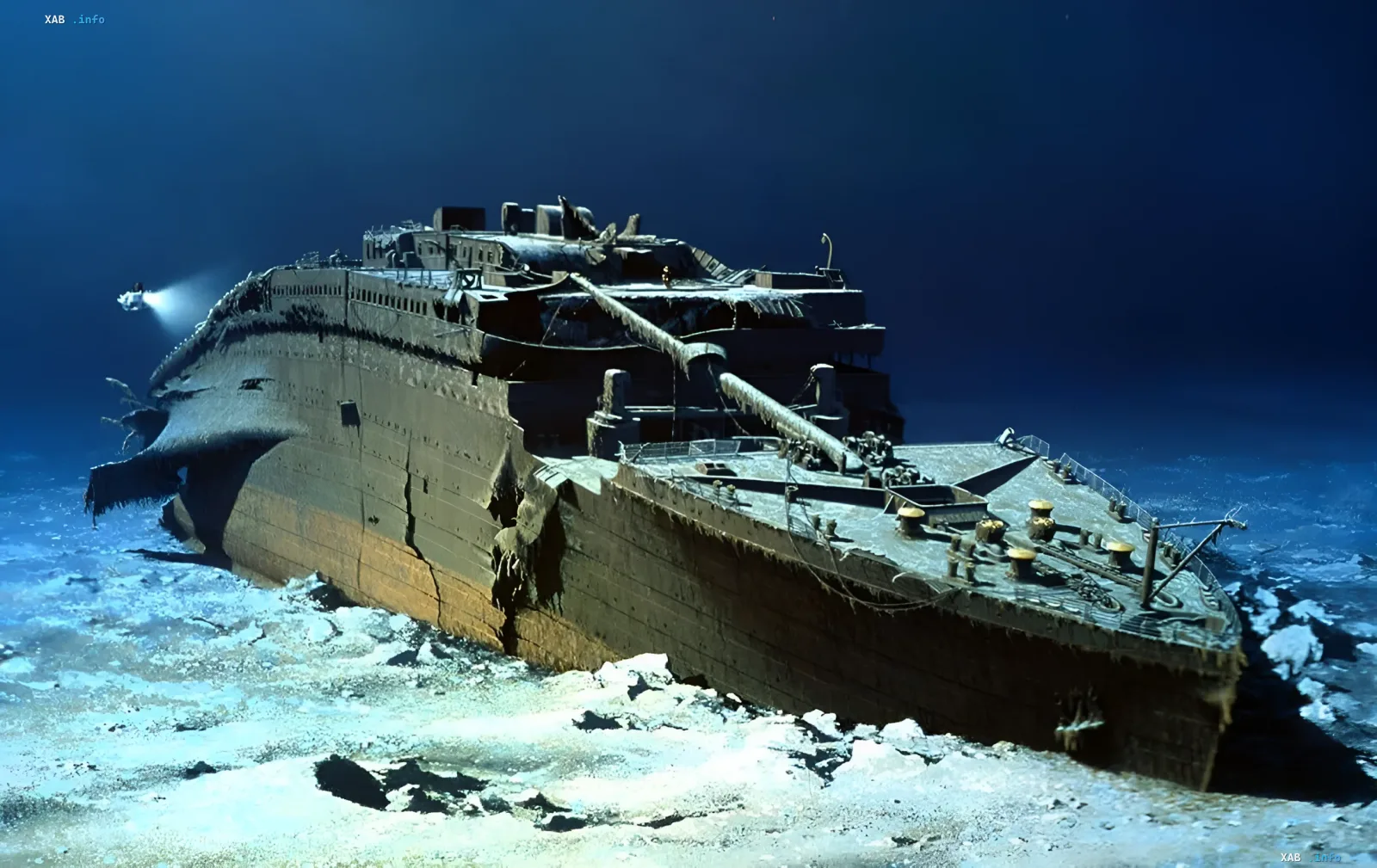
More than 110 years after its sinking, the “Titanic” continues to gradually disappear on the floor of the North Atlantic. The wreckage of the legendary passenger liner lies at a depth of about 3,800 meters, where the steel structures are subjected around the clock to salt water, ocean currents, high pressure, and—especially destructively—microorganisms that consume metal. What still looked like a relatively intact hull at the end of the 20th century is now a set of deforming fragments that become harder to recognize from old photographs with each new expedition.
Causes of Destruction: “Rust Stalactites” and Iron-Eating Bacteria
One of the main causes of the ship’s decay, researchers say, is iron-consuming bacteria (so-called iron-eating microorganisms). As a result of their activity, characteristic rusty growths form on the surface of the wreckage—“rust stalactites”—that literally eat away at the steel from the inside. As these deposits accumulate, the structures lose strength, bend, and ultimately collapse. The combination of this biological factor with the physical pressure of the depths and the mechanical impact of currents makes the destruction process virtually irreversible.
What Researchers Record on New Dives
Over the years of observation using submersibles, scientists have documented numerous changes in the configuration of the wreckage. Parts of the railings and other superstructures have already broken off the liner, some sections of the decks have collapsed, and elements of the ship familiar from historical photographs are becoming harder to recognize. The bow of the ship is the most visibly damaged, as it is the first to deform under its own weight and the impact of oceanic processes.
Digital Preservation: 8K Filming and Three-Dimensional Models
In 2022, OceanGate Expeditions carried out an expedition during which the “Titanic” wreckage was filmed in 8K format. The ultra-high resolution made it possible to examine details of the hull that had previously been difficult to distinguish in underwater video recordings. This is why modern expeditions pay increasing attention not only to research but also to digital documentation: scientists are creating detailed photographs and three-dimensional models of the ship that allow its structure to be studied in virtual space. Such a model is especially important because the physical remains of the liner continue to change—it allows the most accurate possible representation of the “Titanic” in its current state to be preserved even after individual parts have completely disintegrated.
Contradictory Data
The question of when the liner will completely disappear remains open and, in this sense, contains inconsistencies in the estimates. On the one hand, researchers explicitly note that the exact time of the “Titanic’s” complete destruction cannot be predicted—the process depends on a multitude of variables that cannot be modeled with high accuracy. On the other hand, there are suggestions that within the next few decades a significant portion of the structures may disappear, leaving behind mostly fragments of metal and a layer of corrosion. In other words, a gap persists between the position that “a forecast is impossible” and the estimate that “only decades remain,” a gap that the scientific community is currently unable to narrow.
Historical Context: From Belfast to the Ocean Floor
The “Titanic” was built by the British company Harland & Wolff in Belfast; at the time of its completion, it was one of the largest and most famous passenger liners in the world. On the night of April 15, 1912, during its maiden voyage from Southampton to New York, the ship struck an iceberg and sank, with more than 1,500 people losing their lives. The liner’s wreckage was discovered in 1985 on the floor of the North Atlantic, and since then it has been studied numerous times using submersibles. Each new expedition helps not only to learn more about the legendary ship but also to document its condition before the ocean finally changes its appearance.