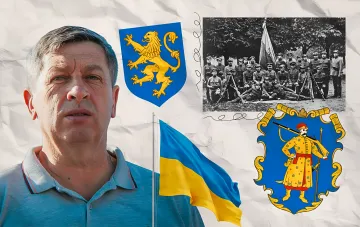
In Ukraine, a debate periodically resurfaces over what the "correct" color arrangement on the national flag should be. Proponents of the "flipped flag" version argue that the yellow stripe should be on top and the blue one on the bottom. However, according to Yuriy Savchuk, an expert in heraldry and vexillology and the director-general of the Museum of the History of Ukraine in the Second World War, historical documents and everyday practice in the use of Ukrainian symbols tell a different story. He shared this in an interview with RBC-Ukraine.
Where the "flipped flag" theory came from
According to Savchuk, the idea of a yellow-blue color sequence partly traces back to the academic approach to heraldry. Traditionally, it is believed that the color of the coat of arms should be placed in the upper part of the flag. In the Ukrainian tradition, that color is gold: the golden trident, the golden Cossack with a musket, the golden lion on a blue background. "From this approach, our flag should be yellow-blue or yellow-light-blue," the expert explained. It is precisely this academic approach, he says, that gave rise to the idea that the yellow stripe should be on top.
Historical practice vs. theory
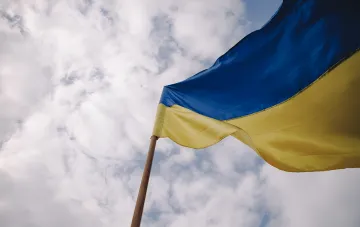
Nevertheless, Savchuk emphasizes that "theory is gray, but the tree of life is green," and that practice is the criterion of truth, quoting Goethe's literary character Faust. In his words, in Dnipro Ukraine, and then in the normative legal acts of the period of the Ukrainian People's Republic and the Ukrainian State under Pavlo Skoropadsky, legislative norms and everyday use confirmed precisely the combination of blue and yellow in the order that is enshrined today.
Contradictory data
Separate disputes arise over photographs from the UPR era on which the yellow stripe is allegedly on top and the blue one on the bottom. In the expert's assessment, some of these cases can be explained by the peculiarities of photochemistry of that time: on black-and-white shots, blue could appear light and yellow dark, creating the illusion of a "flipped" flag. At the same time, Savchuk acknowledges that there were isolated cases in which the yellow color really was placed on top. Thus, the academic heraldic theory, historical practice, and the disputed archival photographs offer three different perspectives on the same question, and it is precisely their overlap that gives rise to public disagreement.
The diaspora and the role of intelligence services
In the 1920s–1950s, in the Ukrainian emigration, particularly in the diaspora in the USA, the debate over the flag's color sequence was especially heated. The expert notes that it was fueled by the intelligence services of the Soviet Union: "Back then they tried to split Ukrainians along various lines — religious, into Greek Catholics and Orthodox; regional, into 'westerners' and 'easterners.' So one has to be very careful with the question of the flag." In his words, the dispute over the colors became yet another way to divide the Ukrainian diaspora, which advocated for Ukraine's independence.
Information-psychological influence
Savchuk also believes that before the start of the Russian aggression in 2014, the question of the color sequence was used in information-psychological influence aimed at weakening the Ukrainian state. The thesis of an allegedly "fake country" was spread: if, by this logic, Ukrainians themselves cannot determine what their flag should look like, then, supposedly, one cannot speak of a full-fledged state. At the same time, in the expert's words, numerous studies from different regions of Ukraine and scholarly works provide enough answers on the history of the national symbols. "Today we are in complete agreement on the color scheme, the meaning, and the historical roots of our national symbols, of which we are proud and for which our defenders — men and women — give the most precious thing — their lives," he emphasized.