On August 23, Ukraine celebrates the Day of the State Flag. The blue-and-yellow banner seems to us a symbol that has always existed, yet its history is one of centuries of change, debate, and struggle for national identity. Yuri Savchuk, an expert in heraldry and vexillology and the general director of the National Museum of the History of Ukraine in the Second World War, told RBC-Ukraine where the combination of blue and yellow originates, why fierce discussions were held over the order of the stripes, and how the Soviet authorities tried to erase this symbolism from public space.
Princely Banners and the Cossack Tradition: The Root Colors
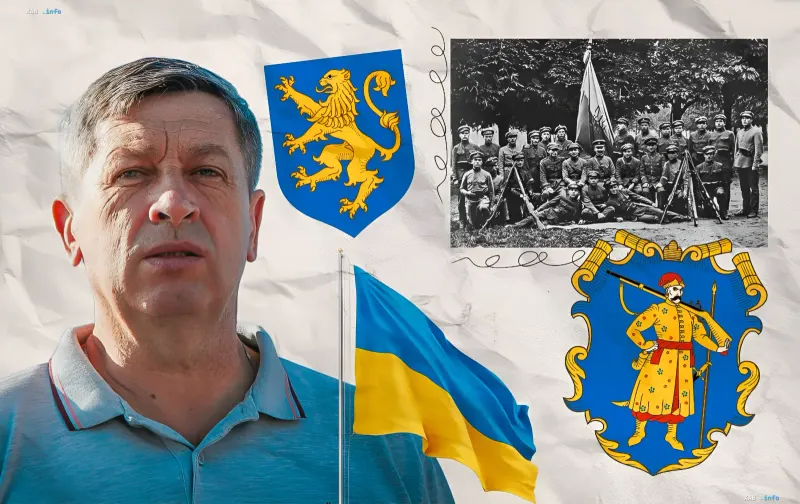
In the era of Kievan Rus', banners served primarily a signaling function in battle: the princely flag marked the location of the ruler and the commander of the army. That is why the banners of the time were made in the most conspicuous tones — above all red, which most often appears in miniatures and in chronicle illustrations. The blue-and-yellow palette was not yet forming as a national code during that period. The turning point came in the 16th–18th centuries, when the Ukrainian hetmans adopted a coat of arms depicting a Cossack armed with a musket. The key moment was the reform under the last hetman, Kyrylo Rozumovsky: the production of regimental and company flags was for the first time financed centrally. Before that, each regiment or company sewed its banners at its own expense, which gave rise to an enormous palette. After the reform, a unified tradition gradually took hold — a golden Cossack with a musket on a blue field. Thus blue and gold became the established colors of the Cossack host, and later of the entire Ukrainian national symbolism.
The 'Spring of Nations' and the Galician Lion: The Western Wing of the Colors
Throughout the 19th century, a significant part of western Ukrainian lands was part of the Austro-Hungarian Empire. In 1848, on the wave of the so-called 'Spring of Nations,' the subjugated nations of the empire began actively defending their national and state life — Ukrainians among them. In Galicia, a coat of arms with a golden lion on a blue field had been used for centuries, and it was precisely during this period that the combination of blue and gold came to be perceived as a marker of national distinctiveness. This was aided by the desire to fit Ukrainian symbolism into the pan-European practice of national flags. Thus, in the west of the country, the blue-and-yellow palette was established through the heraldry of the lion, while in the east — through the image of the Cossack with a musket. Two independent heraldic paths converged on the same color pair.
The Poetic Interpretation — a Consequence, Not a Cause
In Sloboda Ukraine, then part of the Russian Empire, the mass use of blue and yellow as a sign of national life began only in the early 20th century. The colors came to be used at major anniversaries of Ukrainian figures in the arts, at rallies, when during the First Russian Revolution the Ukrainian national movement was actively defending cultural and political rights. It was precisely in the first decade of the 20th century that the poetic interpretation emerged: the blue sky over golden ears of grain. However, as Savchuk emphasizes, this interpretation appeared after the fact. First the color combination itself arose, then it became a symbol of national distinctiveness, and only over time were various semantic interpretations 'fitted' to it. It is in this sequence — from practice to poetics — that the history of the Ukrainian flag should be viewed.
Contradictory Data
A persistent debate exists over the order of the stripes of the Ukrainian flag, in which heraldic theory and historical practice collide. From the standpoint of the strict rules of heraldry and vexillology, the color of the figure — in the Ukrainian tradition this is gold (the golden trident, the golden Cossack, the golden lion) — should be placed in the upper stripe of the flag. Following this academic approach, the 'correct' variant would be a yellow-blue or yellow-sky-blue banner. This theoretical position gave rise to the idea that the upper stripe should be yellow. However, as the literary character Goethe's Faust noted, 'theory is dry, but the tree of life flourishes': it was practice that became the criterion of truth. In Sloboda Ukraine, and then in the normative-legal acts of the period of the Ukrainian People's Republic and the Ukrainian State under Skoropadsky, legislation and everyday practice confirmed the dominance of precisely the blue-yellow order — blue on top, yellow below. Additional complexity is added by photographs from the era of the Ukrainian People's Republic, on which the yellow color is sometimes seen on top and the blue below. According to Savchuk, this is most often explained by the peculiarities of the photochemistry of the time: the blue color on black-and-white shots of that period was rendered as light, creating the visual impression of an 'inverted' flag. Moreover, historical sources record a variant in which a magenta color was proposed to be added to the blue-yellow palette, but this project never received legislative codification. Thus, the question of the order of the stripes remains one of the most debated topics in Ukrainian vexillology, where the theoretical ideal and the historical reality do not always coincide.
From the Ukrainian People's Republic to the Present: The Flag as an Object of Struggle
After the establishment of Soviet power, the blue-and-yellow symbolism was systematically driven out of public space: flags were burned, heraldic images were destroyed, and any attempts to reproduce the national symbolism were persecuted. The restoration of the blue-and-yellow flag as a state one occurred only in 1992, when the Verkhovna Rada of Ukraine adopted the corresponding law. Since then, August 23 — the Day of the State Flag — has become not only a legal but also an emotional point on the calendar: it reminds us that behind the two stripes of color stand centuries of Cossack tradition, Galician heraldry, the revolutionary rallies of the early 20th century, and years-long debates over which order of stripes is the 'correct' one. The history of the flag of Ukraine is the story of how a color, born in a regimental camp and on Galician coats of arms, turned into the nation's principal visual code.