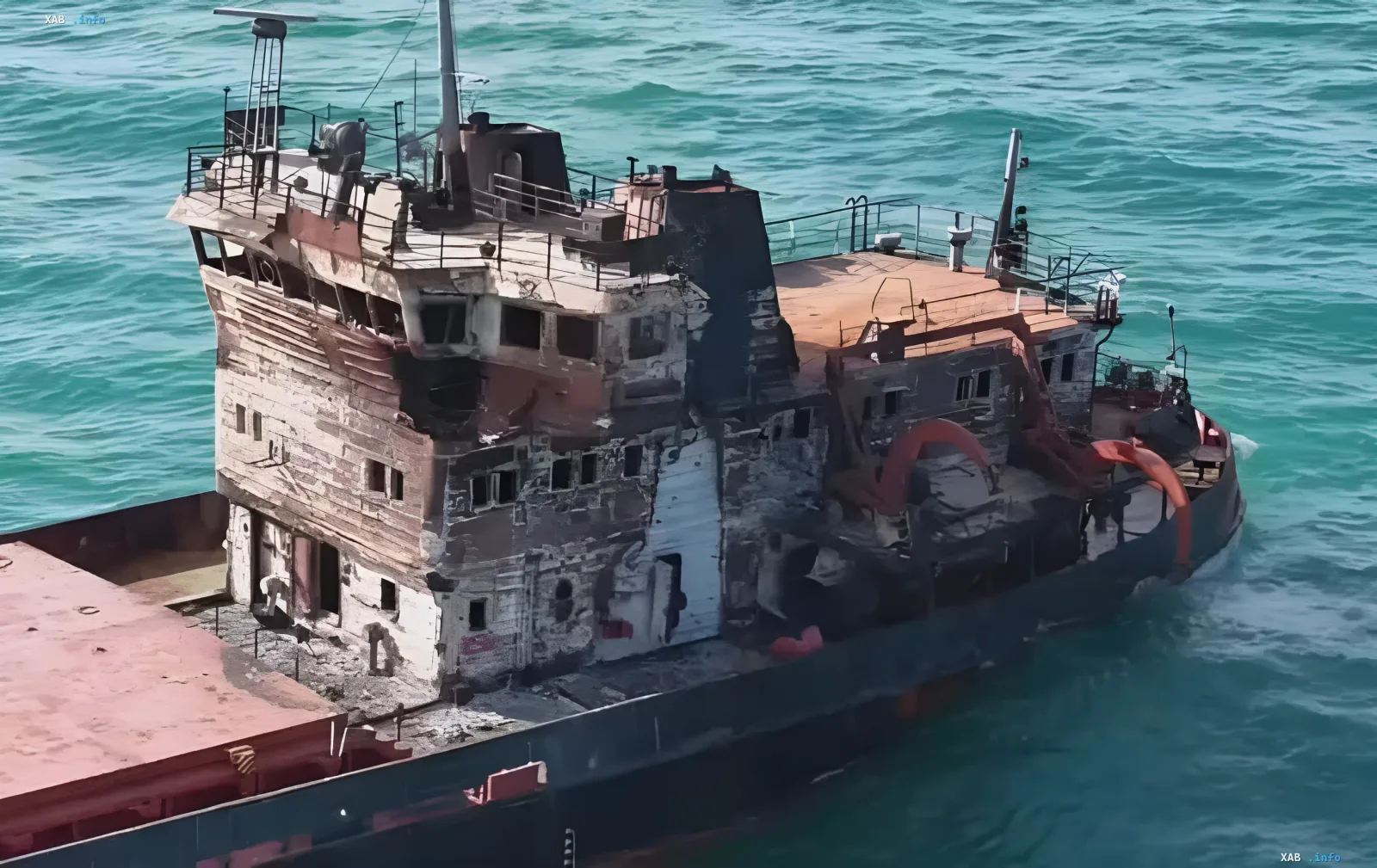
On the night of 31 August 2026, the burnt Russian cargo vessel 'Omsky-107', 108 metres long, ran aground off the Turkish coast in the Şile district. According to the Turkish news agency DHA, as cited by RBC-Ukraine, the ship had been attacked near the port of Novorossiysk, after which, having lost propulsion and steering, it began drifting across the Black Sea toward the Turkish shore. The crew, as established by the rescue teams that arrived on scene, had abandoned the vessel in lifeboats immediately after the attack, so by the time the ship was washed onto the shallows it was empty.
How the vessel ended up off the Turkish coast
The ship, flying the Russian flag, drifted toward the coast until it ran aground near Alacalı Beach in the Şile district. Local residents, who noticed the ship approaching the shore, reported the find to the coast guard. The crews that arrived on scene took safety measures in the grounding area and began the inspection: the bridge was found to be burnt and heavily damaged, while the deck and superstructures were destroyed. The grounded vessel was filmed from the air, documenting the scale of the damage and the absence of any people on board.
Crew and circumstances of the attack
According to DHA, as relayed by Ukrainian and international media, the crew evacuated in lifeboats immediately after the attack, so by the time the coast guard inspected it, the vessel was empty. The Ukrainian outlet 'Hromadske' (svoboda.org) clarifies that the damage to the vessel was caused by a drone strike, which is consistent with the charred bridge and destroyed superstructures visible in the aerial imagery. Thus, the incident represents a rare case in which a vessel damaged in combat independently, without a tug, crossed a significant part of the Black Sea and was washed onto a foreign coast.
Context: a series of strikes on Novorossiysk
Novorossiysk has more than once been the target of large-scale strikes. On 12 August 2026, a state of emergency was declared in the city following attacks by the Ukrainian Defence Forces on the Russian naval base — the last major support point of the Russian fleet in the Black Sea. According to President Volodymyr Zelenskyy, it was a 'unique operation' carried out at a distance of more than 300 km from the front line, using 'Palianytsia' loitering munitions, 'Neptune' missiles and maritime unmanned systems. It later emerged that the grain terminal in Novorossiysk had suspended operations after the attack. The incident with the 'Omsky-107' fits into this series of events and points to continuing pressure on Russia's Black Sea infrastructure.
Contradictory data
There are discrepancies in the details in open sources. First, in the initial RBC-Ukraine report the attack is described without specifying a particular weapon, whereas svoboda.org directly names a drone strike as the cause of the damage; there is no independent confirmation of the type of weapon used in the provided materials. Second, the vessel name 'Omsky-107' formally echoes the Omsk Refinery, however sources ID 3 and ID 4 (glavred.info, tumen.kp.ru) relate to an entirely different event — the strike on the Omsk oil refinery 2,500 km from the border — and have no connection to the maritime incident near Novorossiysk. Mixing these facts in publications may distort the picture, so in this article they are treated as separate events.
Significance of the incident
The washing ashore of a burnt Russian vessel on the Turkish coast has several consequences. On the one hand, it is a clear indication that the Black Sea waters and Russia's port infrastructure remain vulnerable, and that damaged vessels are capable of drifting for hundreds of kilometres, creating risks for shipping and the environment. On the other hand, the incident involves Turkey — a NATO country — whose territorial waters and coastal zone have been drawn into the aftermath of hostilities, which may trigger diplomatic and technical procedures for the disposal of the vessel and the assessment of possible fuel spills. As of the time of publication on 31 August 2026, the Turkish coast guard was continuing the inspection and ensuring safety in the grounding area.