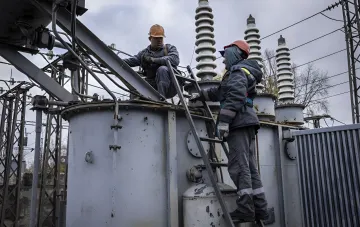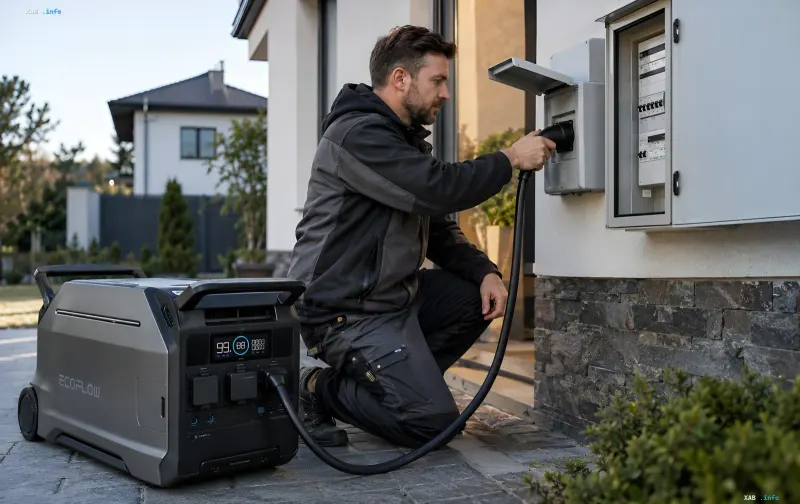
The upcoming winter will once again become a severe test for Ukrainians: Russian military strikes on thermal power plants and critical infrastructure make preparing for prolonged power outages not just a matter of comfort, but an element of safety and survival. Under conditions where blackouts can last for days, autonomous power sources cease to be a luxury and turn into a necessity. RBC-Ukraine media has prepared a selection of five powerful portable power stations capable of providing a home with basic energy supply during the coldest months.
Third-Generation Model: 4,000W and Quiet Operation
The first station in the ranking is designed specifically for household use and features high power with a low noise level. The rated power is 4,000W, and the peak reaches 8,000W — enough to start air conditioners or deep-well pumps. The 4,096Wh battery is built on LiFePO4 cells with a lifespan of over 4,000 cycles before retaining 80% capacity. Charging to 80% takes 50 minutes, a full grid cycle takes one hour. The X-Quiet cooling system limits noise to 30 dB, and support for solar panels up to 2,600W allows partial energy replenishment off-grid. The device weighs 51.5 kg, and transport wheels compensate for its dimensions.
High-Power Integrated System for Home and Electric Vehicles
The second station in the selection is positioned as a full backup for a home power system or a power source for electric vehicles. The rated power is 6,000W, with a peak of up to 9,000W. The base battery capacity is 3,840Wh, but the system is expandable up to 26.9 kWh. The LiFePO4 battery is rated for over 3,000 cycles. Full grid charging takes 1.28 hours. The device weighs 60 kg, features a suitcase-type body, and has a 230V/16A output.
Time-Tested Solution and Modular System
The third station is a classic solution that proved its reliability during past severe blackouts. Rated power is 3,600W, rising to 4,500W in X-Boost mode, with a peak of 7,200W. The 3,600Wh capacity expands up to 10.8 kWh, and the LiFePO4 battery withstands 3,500 cycles. Grid charging takes 1.9 to 2.7 hours, weight is 45 kg. Special attention should be paid to the possibility of integration into the home electrical panel via Smart Home Panel. The fourth model is a modular system with a separate design: the power inverter is separated from the battery unit. The inverter delivers 3,000W with a peak load of up to 6,000W and pure sine wave. The B300 module has a capacity of 3,072Wh, connecting up to four blocks gives a total capacity of 12,288Wh. Grid charging takes 1.5 to 1.8 hours. The inverter weighs 21.6 kg, the battery unit 36.1 kg. The base kit price in Ukraine ranges from 88,599 to 105,304 hryvnias.
Maximum Capacity in a Single Body and UPS Mode
The fifth station demonstrates one of the highest base capacity figures without the need to purchase additional battery modules. The P5000 version delivers 2,200W, while the P5000 Pro model offers 4,000W with a peak value of up to 8,000W. The 5,120Wh capacity based on LiFePO4 with a lifespan of over 3,500 cycles ensures basic appliance operation for 1.5–2 days. Charging takes 2–2.5 hours, and UPS mode with a switching speed of less than 10 ms eliminates short-term voltage sags. Weight is 52 kg. Price in Ukraine: from 100,000 to 125,000 hryvnias depending on the modification.
Connection Safety: Two Key Rules
Electricians emphasize: before installing a backup power source, strict technical requirements must be followed. Connecting a power station to the home grid with a «male-to-male» (plug-to-plug) cable is strictly prohibited — a changeover switch must be installed in the electrical panel for safe switching between external power and the station. The second important aspect is the neutral conductor: for the correct operation of certain gas boilers, correct determination of phase and neutral is crucial. Portable stations may have an isolated neutral, causing the boiler not to start. The solution to this problem must be determined by a qualified electrician taking into account the specific model of the station, boiler, and grounding scheme.