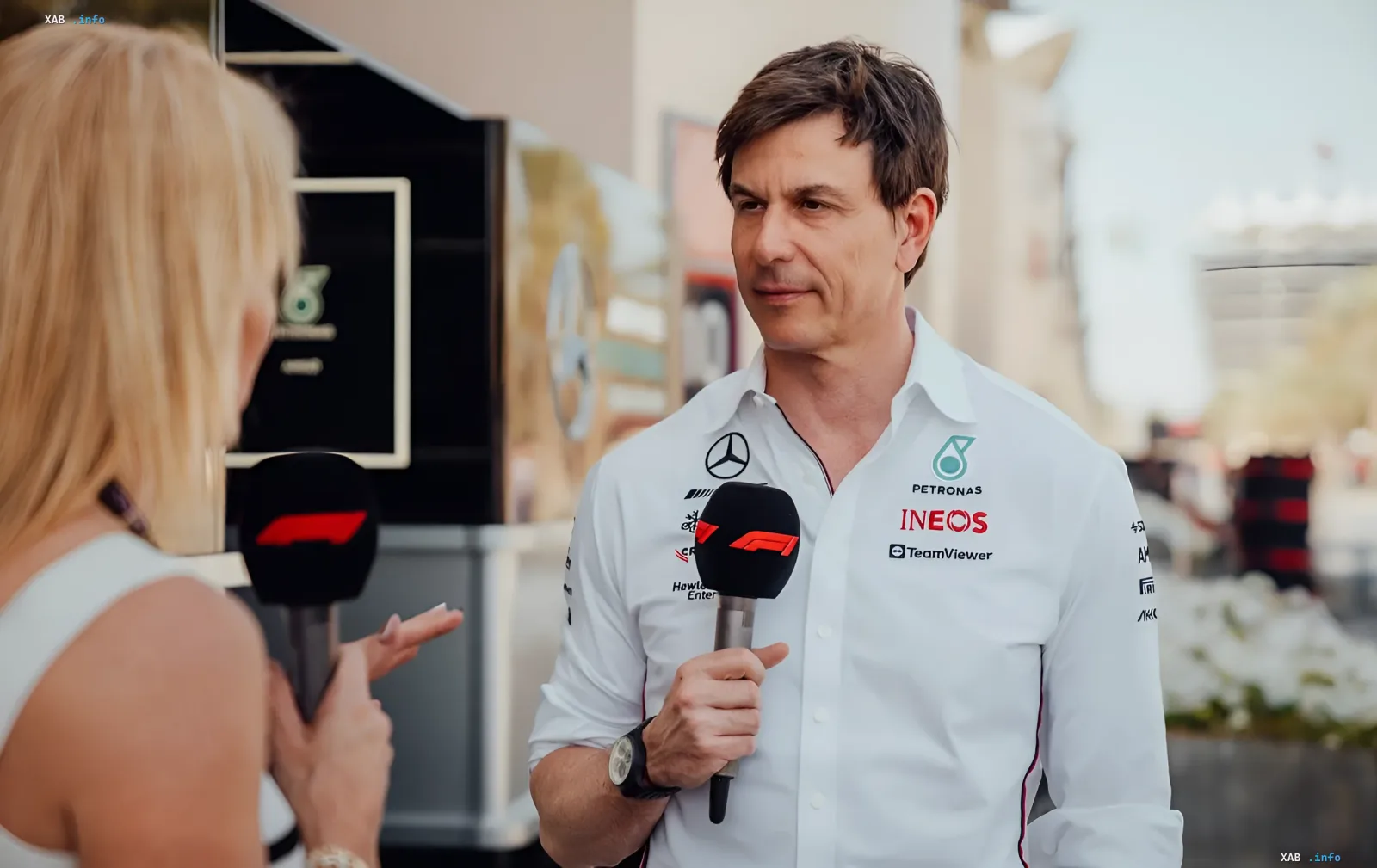
Mercedes team principal Toto Wolff, in an interview with Sky Sports relayed by Ukrainian media outlet Sport RBC.UA, revealed the key problem his team is facing this Formula 1 season: the strict $215 million per-season budget cap prevents the team from keeping up with the pace of technical updates being delivered by McLaren and Ferrari. According to Wolff, Mercedes is forced to distribute its budget extremely carefully throughout the championship in order to stay within the strict financial regulations, while its rivals have opted for a more aggressive and riskier development strategy.
The update race and the hard budget cap
Wolff stated outright that Mercedes “doesn’t have the money right now for regular car updates.” The team, he said, is trying to spread its spending evenly across the entire season so as not to exhaust its limit at an early stage. At the same time, the “Silver Arrows” boss emphasized that a genuine “update race” is underway in Formula 1: every package of aerodynamic or technical upgrades brought in by the rivals shrinks their gap to the leader by 0.1–0.2 seconds. It is precisely this gap, in Wolff’s assessment, that makes the battle with McLaren and Ferrari particularly difficult, since every new part fitted by the opponents effectively reshuffles the balance of power on track.
Rivals’ risky tactics
In Wolff’s view, McLaren and Ferrari have deliberately taken on greater financial risk by investing a significant share of their budget cap in frequent update packages at the early stages of the championship. Their rivals are betting on an immediate result: the maximum number of new parts is being brought to the track “here and now,” which allows them to quickly close the gap to the leader and even take the lead at certain circuits. Wolff does not hide that such a tactic requires teams to be ready to sacrifice financial flexibility in the second half of the season in exchange for a short-term advantage in the races.
Doubts about the sustainability of rivals’ pace
Despite acknowledging the difficulty of the current situation, Wolff cast doubt on McLaren’s and Ferrari’s ability to maintain such an intense update pace through to the end of the year. The Mercedes boss suggested that his rivals’ “financial resources will run out quickly,” since spending a large share of the cap at the start of the season leaves little room for manoeuvre at the autumn stages of the championship. Thus, Wolff effectively hinted that his team’s strategy — an even distribution of the budget — may prove more sustainable in the long term, even if in the short term it lags behind in the speed of technical updates.
Context: Mercedes’ lead and Norris’ winning streak
At the time of Wolff’s statement, Mercedes holds the leading position in the current Formula 1 season, however its closest pursuers — McLaren and Ferrari — have significantly narrowed the gap thanks to their frequent update packages, and at some circuits are already demonstrating a faster pace. Additional context is provided by the recent result of McLaren driver Lando Norris, who won his second race in a row, clearly confirming the effectiveness of the aggressive technical development strategy chosen by his team. It is under such conditions that Wolff’s words about a lack of funds for regular updates sound like an admission that maintaining the lead under the budget cap is becoming increasingly difficult.