Imagine that carbon dioxide is dust that settles in the air. To remove it, you usually need to either ventilate the room (which is not always effective) or use a vacuum cleaner that heats up and consumes a lot of energy. But what if there was a way to collect this 'dust' without heating and with minimal costs? This is exactly the challenge that engineers from the University of Illinois and Toyota have solved.
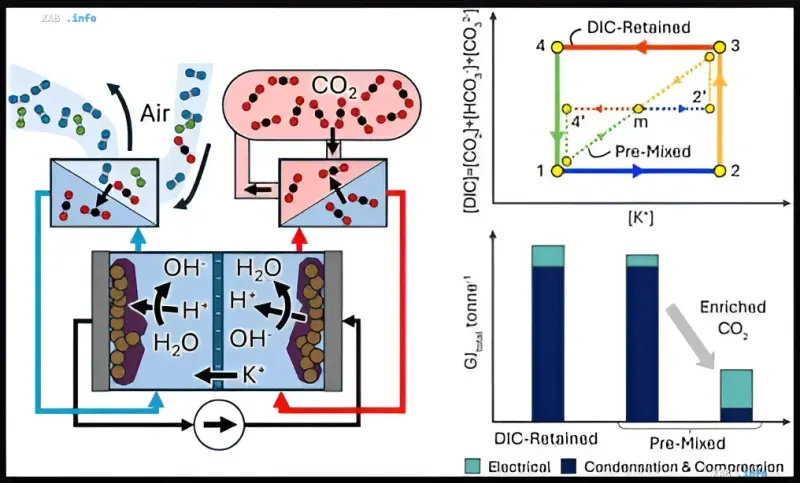
A joint group of researchers presented a prototype of an electrochemical cell that works like a smart battery. It is capable of capturing carbon dioxide ($CO_2$) directly from the atmosphere without requiring the high temperatures typical of existing industrial installations.
The results of testing this development have already been published in the prestigious international journal Environmental Science and Technology. The main goal of the project is not just to clean the air, but to create a raw material base for the production of eco-friendly fuel.
How does the 'chemical battery' work?
Modern Direct Air Capture (DAC) systems work on the principle of thermal desorption. Simply put, they use special materials that absorb carbon dioxide, which must then be strongly heated (from 100 to 900 degrees Celsius) to release the pure gas and reuse the material. This is a very energy-intensive process.
The new technology, developed under the leadership of Professor Kyle Smith, does away with heating. Instead, it uses electricity and an aqueous salt solution. The process can be compared to the operation of a battery that changes its properties depending on how current is applied to it.
The cell's operation is divided into two stages:
- Collection stage (absorption): When current is applied to the manganese dioxide electrodes, the solution becomes alkaline. In such an environment, carbon dioxide from the air passing through the system 'sticks' to the molecules and turns into carbonate ions.
- Release stage (desorption): As soon as the polarity of the current changes, the solution becomes acidic. Under these conditions, carbon can no longer be held in the solution and is released as a high-concentration pure gas.
All this magic happens at room temperature, which makes the process potentially much more efficient in terms of energy consumption.
Why does Toyota need this?
The participation of the automotive giant in the project is not accidental. For Toyota, this is a strategic step in technology diversification. The captured $CO_2$ can be used in two key areas:
- Synthesis of e-fuels: In combination with hydrogen, the captured carbon can be converted into carbon-neutral fuel for internal combustion engines. This will allow cars to operate without increasing the total volume of emissions into the atmosphere.
- Autonomous filtration: Engineers are considering the possibility of creating compact modules that can be installed directly in vehicles to locally reduce carbon concentration.
Limitations and prospects
Despite the success, the technology is still at the prototype stage. Engineers have encountered a problem called the 'cross-mixing effect'. When switching modes, the electrolyte flows partially mix, which reduces the efficiency of the system. Currently, scientists are working on optimizing the geometry of the channels inside the cell to isolate the flows from each other.
Experts note that achieving carbon neutrality by 2050 is impossible solely through emission reductions. Direct capture technologies like this one can become a critically important tool for balancing the planet's climate system.