

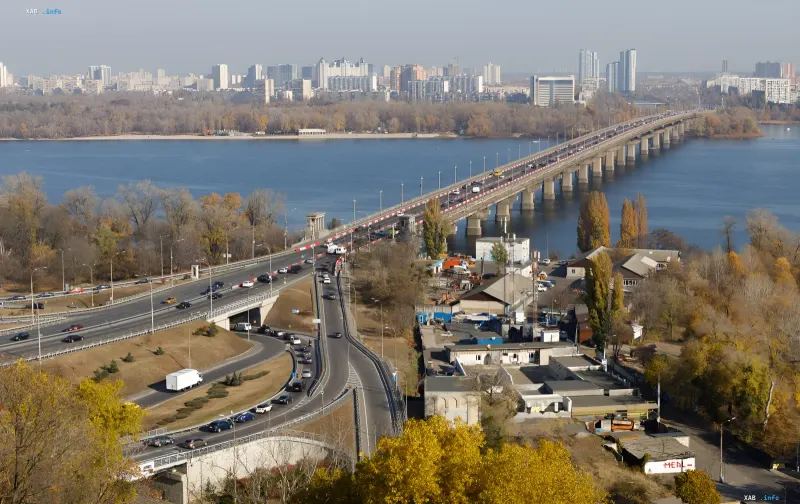
On the morning of October 2, 2026, a massive transport collapse unfolded in Kyiv due to severe traffic restrictions on key bridges across the Dnipro River. Closures and disruptions in the operation of crossings paralyzed communication between the left and right banks of the Ukrainian capital, causing miles-long traffic jams and huge queues at public transport stops. The situation on the roads remains critical, forcing citizens to look for alternative ways of getting around.
Chronology of Attacks and Reasons for Bridge Closures
Serious logistics problems were the result of a series of targeted strikes by Russian forces on Kyiv's transport infrastructure facilities recorded on October 1 and 2, 2026. According to city authorities and law enforcement, the Pivdennyi (South) Bridge suffered several drone attacks: the first hits near the support part occurred on the afternoon of October 1, after which traffic was urgently stopped. On the evening of the same day, another strike followed, damaging the bridge support, guardrail, roadway, and protective concrete metro barrier, causing specialists to de-energize the tracks. A new attack was recorded on the night of October 2 at around 05:03 AM, after which emergency services promptly arrived at the scene.
Large-scale Traffic Jams and Walking Across the Dnipro
As a result of the introduced restrictions and infrastructure damage on the Metro Bridge, traffic is allowed only in one lane, and the South Bridge is completely blocked in both directions. On the morning of October 2, massive traffic jams formed in the area of the Paton Bridge and along the Dniprovska Embankment towards the right bank, paralyzing traffic. Unwilling to wait in endless queues for buses, thousands of Kyiv residents decided to cross the Dnipro on foot, moving in dense columns directly along the pedestrian zones of the bridges, which is massively recorded on video in social networks.
Public Transport Operations and Alternative Routes
City authorities are promptly restructuring public transport logistics, transferring bus routes to temporary schemes. In particular, buses No. 22 and No. 91 were rerouted via the Darnytsia Automobile and Railway Bridge through Bazhan Avenue, Dniprovska Embankment, and Prydniprovske Highway. During announced air raid alerts, additional temporary branches operate for these routes. Kyiv City Express continues to demonstrate stable operation between the banks — the Kyiv ring train runs strictly according to the full schedule.
Contradictory Data
While Ukrainian specialized departments and the Kyiv City State Administration promptly report on targeted damage to the roadbed, supports, and protective structures of the metro on the Pivdennyi Bridge, as well as the transition to reserve bus routes and the stable operation of the ring train, diametrically opposed interpretations of events appear in a number of foreign and Russian sources. Some Russian experts and pro-military telegram channels, citing commentators like war correspondent Sladkov, claim a so-called "complete paralysis" and critical destruction of Kyiv's entire transport system by analogy with the Yugoslav scenario. However, objective on-site data and official reports from Ukrainian services refute these large-scale exaggerations, confirming that the bridges retain their load-bearing capacity and alternative crossings, such as the Darnytsia Bridge and Kyiv City Express, continue to ensure connection between the banks.
Expert Assessments and Infrastructure Threats
Analysts from the Institute for the Study of War (ISW) note that regular strikes by Russian forces on the same section of the South Bridge may be aimed at the gradual destruction of structures and long-term complication of the capital's transport links. Experts emphasize that such actions constitute a form of social pressure on the civilian population. Nevertheless, the exact type of warhead and the scale of the potential threat continue to be studied by specialized experts.