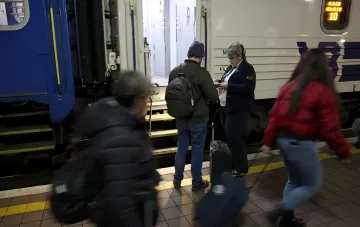
On August 7, 2026, a major disruption to passenger transport schedules occurred on the southern and central routes of Ukraine. Train No. 253/254 on the 'Odessa — Kryvyi Rih' route was forced to make three stops en route due to the threat of unmanned aerial vehicles (UAVs). The incident, which took place in the Mykolaiv and Dnipropetrovsk regions, led to the evacuation of passengers into open areas under conditions of extremely high air temperatures.
Incident chronology and evacuation conditions
According to official data and eyewitness accounts, a prolonged air raid alert was declared along the train's route on the morning of August 7. The cause was the approach of several groups of strike drones maneuvering in close proximity to the railway tracks. Acting in strict accordance with dispatcher instructions, the locomotive crew stopped the train in fields and at small stations located far from major infrastructure objects to minimize risks.
As part of safety protocols, passengers were evacuated from the carriages and placed in forest belts and natural shelters along the tracks. Meteorological data confirms that on this day, the air temperature reached +37°C. Waiting for hours in such conditions was a serious test for passengers; however, according to the carrier, there were no casualties among citizens or railway workers. The total delay of the train upon arrival at its destination exceeded 12 hours.
Rationale for safety protocols
The decision to evacuate people from carriages into open spaces, which raises questions among the public, is based on an analysis of real combat incidents from recent weeks. On July 24, 2026, just two weeks ago, an incident occurred in the Dnipropetrovsk region where a Russian drone struck a passenger train locomotive directly while it was moving. In that case, the timely stop of the train in a field allowed passengers to be evacuated minutes before detonation. The locomotive was destroyed by fire, but human lives were saved.
Ukrzaliznytsia experts explain that a passenger carriage does not possess protection against shrapnel and blast waves. Being in open space, in depressions, or behind embankments statistically reduces the risk of death in the event of a hit on the train. Thus, current measures, despite their discomfort, are the only effective algorithm for saving lives during the active phase of the conflict.
Impact on logistics and alternative routes
The situation on August 7 became one of the most difficult for railway logistics in recent times. Due to the deteriorating situation and strikes on infrastructure, 'Ukrzaliznytsia' was forced to urgently change the routes of a number of trains on the Dnipropetrovsk, Kharkiv, and Zaporizhzhia directions. On some sections, train movement was completely suspended, and passengers were transported via special bus transfers.
Questions about the necessity of a 'one-time solution' and ending the war, which arise in society against the backdrop of such incidents, reflect deep public fatigue. However, according to the current operational situation, complex conflicts do not have instant solutions, and the priority remains ensuring the safety of people here and now.