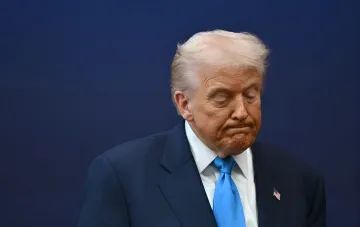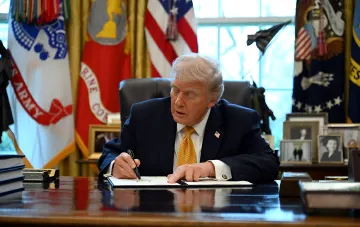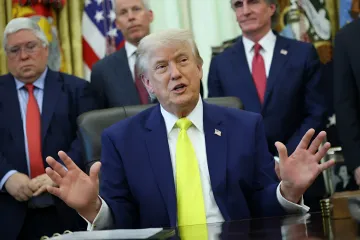
On 24–25 August 2026, the administration of US President Donald Trump announced a shift to total economic warfare against Iran under the working name "Operation Economic Outcast" (referred to in public discourse as "economic D-Day"). At the same time, the White House chief sharply rejected the findings of a fresh Reuters/Ipsos poll, which recorded a drop in approval of his performance to 33% against 64% disapproval, and accused "left-wing Democrats" and "fake media" of falsifying the results. The statement came against the backdrop of a six-month armed conflict that began on 28 February 2026, and four months before the 3 November 2026 congressional midterms, making the combination of economic and political factors a key subject of analysis.
Macroeconomic context and the fuel crisis
The central macroeconomic consequence of the protracted conflict has been the disruption of logistics on energy markets. Iran's naval blockade and closure of the Strait of Hormuz pushed the retail price of gasoline in the US up by more than a dollar per gallon (roughly 38% year on year). For the voter, this translated into a direct cut in real incomes and rising inflation expectations. According to the same Reuters/Ipsos poll, 83% of respondents believe the conflict has taken on the character of a war of attrition, despite the White House's initial claims that the operation would be wrapped up within weeks. Support for Trump's campaign even within the Republican Party's own electorate fell from 77% to 69%, signaling erosion of the core electoral base.
The legal architecture of secondary sanctions
On 24 August 2026, US Treasury Secretary Scott Bessent announced a package of secondary sanctions covering Iran's financial, aviation, technology and gold sectors, as well as digital-asset operations and shipping. The legally significant element of the package was a public warning that any foreign company or jurisdiction continuing to purchase Iranian oil would be fully cut off from the dollar settlement system. The White House stated that there would be no exceptions, not even for Tehran's largest trading partners, including China. The practical implementation of the secondary-sanctions mechanism depends on Washington's ability to enforce compliance controls over cross-border settlements and on the willingness of allied and neutral countries to comply with the ultimatums that, according to reports, Trump is pushing during personal phone calls with heads of state.
Electorate consequences and the domestic political crisis
The coincidence of the sanctions package announcement with the release of a record-low approval rating is no accident. The 3 November 2026 midterms will determine control of Congress, and independent voters, according to polls, are shifting toward the Democratic Party (33% versus 19% in favor of the Republicans). In these conditions, the sanctions rhetoric serves a dual function: on the one hand, it is a tool of economic pressure on Tehran without a ground invasion; on the other, it is an attempt to shift blame for inflation and the logistics crisis onto opponents and to build a narrative of the adversary's "inevitable collapse." Democratic Party leaders, in particular Senator Chris Murphy, characterized the declared "D-Day" as a "desperate smokescreen" designed to mask the absence of military results.
Tehran's reaction and escalation risks
The Iranian authorities reacted to the sanctions threats with restraint. Foreign Minister Abbas Araghchi stated that the country has functioned under sanctions for decades and is "fully prepared" for economic pressure, warning of symmetric measures, including a paralysis of all oil exports from the Persian Gulf. The Pentagon, under Secretary Pete Hegseth, in turn did not rule out new missile strikes should Iran attempt to force-block alternative trade routes. Thus, economic escalation and the military threat remain mutually interlocked, and any breakdown in secondary-sanctions compliance could become a trigger for further militarization of the conflict.
Contradictory data
Open sources record inconsistencies on two fronts. First, the president's public rhetoric ("the real polls show stunning results," "we are beating everyone, including Iran") directly contradicts the Reuters/Ipsos figures (33% approval, 64% disapproval) to which he himself reacted. Second, the parties' positions on negotiations appear contradictory: according to some reports, Trump stated that the US "is not interested in negotiations," while in others he insisted on pursuing dialogue, accusing Iran of denying it; Tehran, in turn, denied the very fact of negotiations, while additional reports spoke of preparations for a new round of talks. Discrepancies in dates and wording along the "negotiations/sanctions/strikes" axis make it impossible to unambiguously reconstruct the sequence of decisions, and both versions are presented without reconciliation.
Long-term consequences
The "economic D-Day" strategy represents an attempt to compensate for the lack of a military breakthrough with a financial ultimatum before the midterm election date. The key systemic risk is that a direct secondary-sanctions threat aimed at major trading partners, above all China, could provoke destabilization of global trade and a new wave of inflation within the US, further undermining the Republican Party's electoral position. In the medium term, the package's effectiveness will be determined not by declarations but by the actual level of sanctions-regime compliance by foreign jurisdictions and by the resilience of the Iranian economy to isolation.