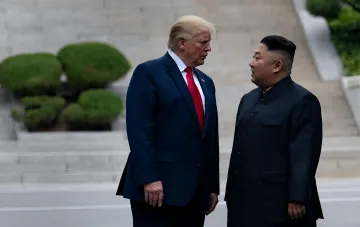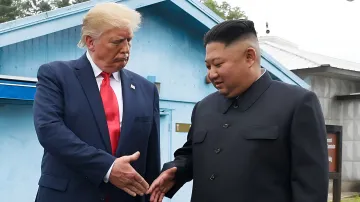
This week, during a visit to China where Donald Trump held talks with Xi Jinping and Vladimir Putin, the US president once again failed to secure a meeting with North Korean leader Kim Jong Un. According to The Wall Street Journal, Washington and Pyongyang hastily discussed the details of a potential leaders' conversation, but the North Korean side put forward conditions that the US deemed unacceptable. American journalists traced how exactly Trump has tried to establish a dialogue with Pyongyang over recent years—and what allows Kim Jong Un to evade Washington's pressure.
Three Meetings and First-Term "Falling in Love"
During his first presidential term (2016–2020), Trump met with Kim Jong Un three times, trying to convince him of the safety of Pyongyang abandoning its nuclear program. According to the Republican's own claims, the leaders of the two countries enjoyed communicating so much that they practically "fell in love" with each other. After returning to the White House in 2024, Trump, as WSJ journalists found out, did not give up attempts to establish dialogue, but now Kim Jong Un, according to sources familiar with the details of the process, is ignoring all signals from Washington.
Silence on the Line and a Letter Thrown at the UN
In 2025, Trump tried to contact the North Korean leader by phone, but no one from Pyongyang answered the proposal to chat through this channel. Trump even indirectly acknowledged this problem, noting that "they have a lot of nuclear weapons, but poor telephone communications." Then the US president decided to write a letter to Kim Jong Un. To ensure the message would go "to the top" via official channels, White House officials developed a whole plan: Trump's representatives waited for a North Korean diplomat near the building of the Permanent Mission of the DPRK to the UN in New York and, using the element of surprise, handed him the letter directly into his hands. Later at a UN meeting, the diplomat threw the unopened envelope in front of the American delegation—thereby showing that Kim Jong Un is neither interested in abandoning his nuclear arsenal nor in friendship with the US president.
An Attempt Through Beijing and "Unacceptable Conditions"
Nevertheless, Trump did not back down and tried to resume negotiations this week—during his visit to China, which included meetings with Xi Jinping and Vladimir Putin. According to WSJ sources, Washington and Pyongyang hastily discussed the details of a potential leaders' talk, but in the end, the North Korean side put forward conditions that the US considered unacceptable. The latest breakdown of potential negotiations, according to the publication, is an illustration of the crisis in which the relations between the two countries find themselves: Washington's long-standing attempts to persuade Pyongyang to abandon the development of nuclear weapons are failing; neither incentives, nor sanctions, nor the isolation of the DPRK are helping.
The Nuclear Status That Washington Is Forced to Acknowledge
As a result, the US is de facto forced to come to terms with the prospect of official recognition of North Korea's nuclear status. As American intelligence stated in its annual 2025 threat assessment, Kim Jong Un "has no intention of abandoning strategic weapon programs through negotiations." According to Washington's estimate, since the last meeting between 42-year-old Kim and Trump in 2019, the North Korean arsenal has grown from 20–30 nuclear warheads to about 60, and the DPRK's intercontinental ballistic missiles can already reach US territory. It is known that the DPRK leader wants Washington to recognize his country as a nuclear-armed state de jure: in February, he stated that peaceful coexistence is possible only if such a status is fixed for North Korea, otherwise the "eternal confrontation" will continue.
Crypto Heists and Rapprochement with Moscow
Among other tools that, according to WSJ, help Kim Jong Un's regime survive under White House pressure are rapprochement with Moscow and alleged participation in massive cryptocurrency thefts. Recently, the DPRK was accused of the largest crypto exchange heist in history, when more than six billion dollars were withdrawn from Binance; although the US later stated they were able to freeze almost half of the stolen funds, the scale of crypto-hacker attacks involving Pyongyang is steadily growing. According to analytical company Chainalysis, the DPRK is purportedly responsible for 89% of losses from such crimes globally in 2026—compared to 15% in 2021.
Context: What Pyongyang and Seoul Are Saying
Pyongyang's position remains tough. Kim Jong Un's sister, Kim Yo Jong, commenting on Trump's decision to cut the scale of joint drills with South Korea, called even the reduced exercises "provocative and aggressive" and stressed that if Washington hopes these steps will be perceived as a gesture of good will, there will be no response. To Trump's words that the North Korean leader allegedly replied to his message, Kim Yo Jong stated that she is "not aware" of any contacts between Pyongyang and Washington. At the same time, in Seoul, the idea of a Trump-Kim Jong Un meeting was supported, and the US president himself, according to reports, personally insisted on organizing such a conversation. According to WSJ, the latest attempt to contact Kim Jong Un is explained by the fact that Trump, stung by the Republicans' defeat in the midterm congressional elections, is looking for new foreign policy achievements capable of strengthening his legacy on the world stage.