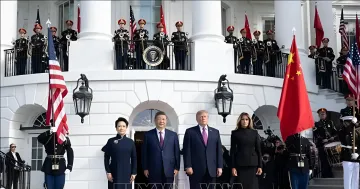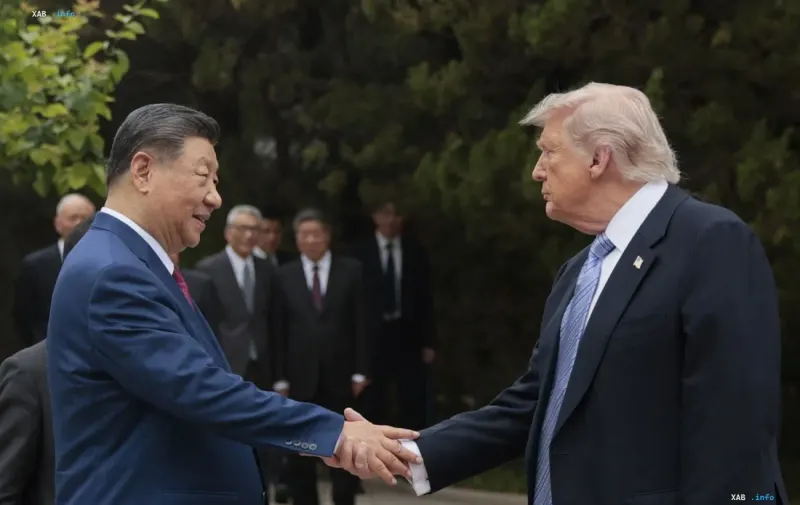
U.S. President Donald Trump personally greeted Chinese President Xi Jinping at Joint Base Andrews, rolling out a red carpet for the Chinese leader. The meeting took place at around 6:00 p.m. local time, when the plane carrying the head of China landed at the airfield in the Washington area. Trump, together with First Lady Melania, walked out to the aircraft stairs, where Xi Jinping and his wife Peng Liyuan were already waiting. According to White House spokesperson Anna Kelly, the gesture is reciprocal in nature: “President Xi received President Trump in China at the historic summit this summer, and President Trump is returning the favor by welcoming the Chinese delegation in a reciprocal visit this week.”
A Diplomatic Gesture Without Precedent in 60 Years
A personal greeting of a foreign leader at Joint Base Andrews is an extremely atypical practice in American diplomacy. The last time a U.S. president stepped onto the airfield to welcome a head of a foreign state was in 1962, when John F. Kennedy received British Prime Minister Harold Macmillan. In the following decades, the airfield was used primarily for ceremonies involving popes: George W. Bush greeted Benedict XVI in 2008, and Barack Obama greeted Francis in 2015. Thus, Xi Jinping became the first sitting head of a foreign state in over six decades to be given a personal reception at the aircraft stairs by the American president.
Military Display on the Runway
In addition to the red carpet, twelve fighter jets were lined up on the ceremony platform: six F-16s and six F-22s. The placement of the combat aircraft against the backdrop of the arriving plane of the Chinese leader became a vivid demonstration of U.S. air power. Analysts note that this combination—a symbolic “welcome” in the form of a red carpet and, at the same time, a visual reminder of military superiority—turns the ceremony into a multi-layered diplomatic signal: on the one hand, respect for the guest; on the other, a display of strength.
Context: How Trump Has Received Other Leaders
For comparison: in February 2025, Trump met Vladimir Zelensky at the entrance to the West Wing of the White House, and King Charles III of the United Kingdom at the South Portico of the residence in April of the same year. Both receptions were conducted within the standard protocol for visits to Washington. Xi Jinping’s last state visit to the U.S. took place in September 2015 under the Obama administration, which makes the current arrival of the Chinese leader an event that breaks a pause of over a decade in personal contacts at the highest level between the world’s two largest economies.
The Asymmetry of Welcomes
Notably, during Trump’s visit to Beijing in May 2026, Xi Jinping did not arrange a similar airport reception for the American president. The White House, in Anna Kelly’s statement, emphasized precisely the “reciprocal” nature of the current ceremony; however, observers point to a marked asymmetry: the American side rolled out an extensive military and protocol infrastructure, while the Chinese side limited itself to a standard reception. This creates additional context for assessing how far Washington is seeking to demonstrate its readiness for dialogue on equal terms.
Geopolitical Background and the Stakes of the Negotiations
The ceremony took place against the backdrop of complex negotiation expectations. According to sources, U.S. allies in Asia are expressing concern that Trump may make concessions to Beijing on the issues of Taiwan or trade policy in exchange for economic agreements. On the eve of the meeting, Vladimir Zelensky appealed to the American leader, asking him to use China’s influence to pressure Russia and proposing to involve Beijing in the mechanisms for settling the Ukraine conflict. Xi Jinping, for his part, upon arrival stated that “China and the United States should be partners, not rivals,” setting the tone for the upcoming consultations. The scale of the ceremonial reception at Andrews, according to diplomatic circles, is intended to create an atmosphere of trust before the sides move on to discussing the most acute trade and geopolitical issues.