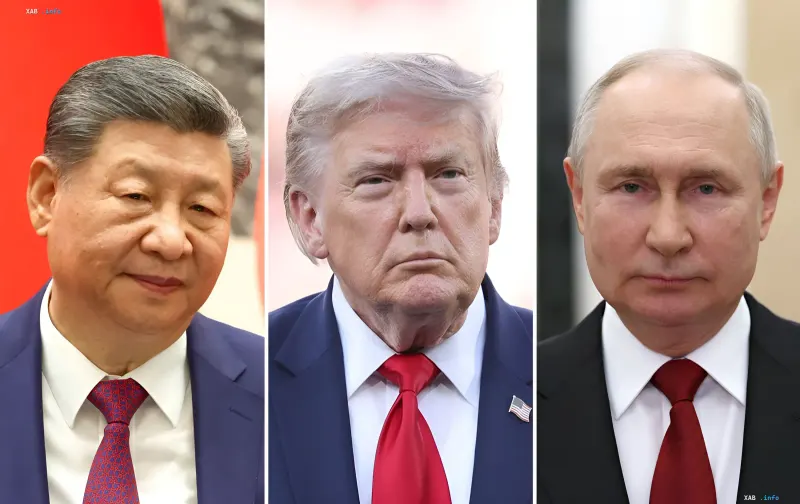
On Thursday, November 19, the first trilateral meeting in modern history between the leaders of the USA, China, and Russia—Donald Trump, Xi Jinping, and Vladimir Putin—will take place on the sidelines of the APEC summit in Shenzhen, China. According to organizers, the talks are scheduled for 14:30 local time. Some foreign media and politicians are already comparing the upcoming summit to the 1945 Yalta Conference, although experts interviewed by them do not expect large-scale agreements from the meeting.
A format that did not exist
Yuri Ushakov, an aide to the Russian president on international affairs, called the upcoming talks the "first contact in this format" and explained that the meeting was designed to reflect the alliance of the three countries during World War II and their cooperation in establishing the UN. The Chinese Foreign Ministry called the summit "pioneering," stating that the leaders would have an "in-depth exchange of views" on "ensuring peace and strategic stability." The Kremlin expects a joint communiqué to be adopted; the text, according to Ushakov, is still being coordinated, and if a common version cannot be reached, each leader will present their own assessment separately.
Agenda: from "nuclear control" to "no list"
Initially, the Trump administration stated that the key issue would be nuclear arms control and the non-proliferation of nuclear weapons. White House Deputy Press Secretary Olivia Wales emphasized that the negotiations are viewed only as a "starting point" for dialogue between the three largest nuclear powers—without expectations of agreements or reductions in arsenals. Other possible topics mentioned included the war in Iran and the situation around North Korea.
At the same time, information about the agenda itself is contradictory. Kremlin spokesman Dmitry Peskov claimed the agenda was already agreed upon, although a number of issues would be "clarified along the way"; Foreign Minister Sergey Lavrov stated on November 17 that it was "essentially formed," and Ushakov reported that Russia and China had submitted proposals for the text of the final statement and were awaiting a response from the US. According to the Financial Times, in reality, the list of issues was not approved by the leaders, and the summit will take place without a pre-agreed agenda.
The Ukrainian issue: a shift in emphasis in two days
A separate intrigue remains Ukraine. Initially, the White House claimed that the Russian invasion would not be discussed at the trilateral meeting. However, before flying to Asia on November 16, Donald Trump personally shifted the focus: "We will also talk about... my favorite topic. Ukraine. Ukraine and Russia are losing 25,000 soldiers every month. So we will talk about that too," the US president declared. According to the FT, given Beijing's reluctance to play a significant diplomatic role in the wars in Ukraine and the Middle East, the leaders may avoid a substantive discussion of these topics in the trilateral format.
Bilateral talks and the absence of special envoys
There is no certainty that a separate bilateral meeting between Trump and Putin will take place on the sidelines of the summit: the Kremlin admits the possibility, and Trump himself spoke about his readiness to meet "if possible." According to The Wall Street Journal, Putin wants to use the meeting to discuss ending the war in Ukraine. At the same time, it was expected that special envoys Witkoff and Jared Kushner, who are actively involved in the settlement process, would be part of the American delegation; however, reports appeared that they would not be present in Shenzhen. Putin's special envoy Kirill Dmitriev explained this by stating they are "involved in separate negotiations with European partners on the future security architecture in Europe."
"Multipolar world" and "economic successes"
On Wednesday, November 18, a day before the meeting with Trump, Putin and Xi Jinping held bilateral talks in Shenzhen that lasted more than two hours. Both leaders declared unity and spoke about the formation of a "multipolar world." The head of the Russian Federation called Xi Jinping a "friend," declared they were working "back-to-back," and boasted of a 43% growth in tourism thanks to the visa-free regime from the PRC. He also claimed that Russia's GDP grew by more than 10% and that inflation is "controlled," remaining silent about the attacks on Russian refineries and the damage to the Crimean Bridge, which was struck by the Ukrainian Defense Forces the day before.
Europe's concern
In Brussels and other EU capitals, the personal meeting between Trump, Putin, and Xi Jinping is heightening concern: officials fear that the leaders of the three powers may discuss or define the future security system of the region without European participation. Against the backdrop of domestic political problems in the US, in particular the Republican defeat in the elections, Bloomberg estimates that Trump may use the meeting to demonstrate international influence and strengthen his image as a strong leader on the world stage. For Xi Jinping, who usually prefers strictly regulated negotiations, such a format is considered atypical.