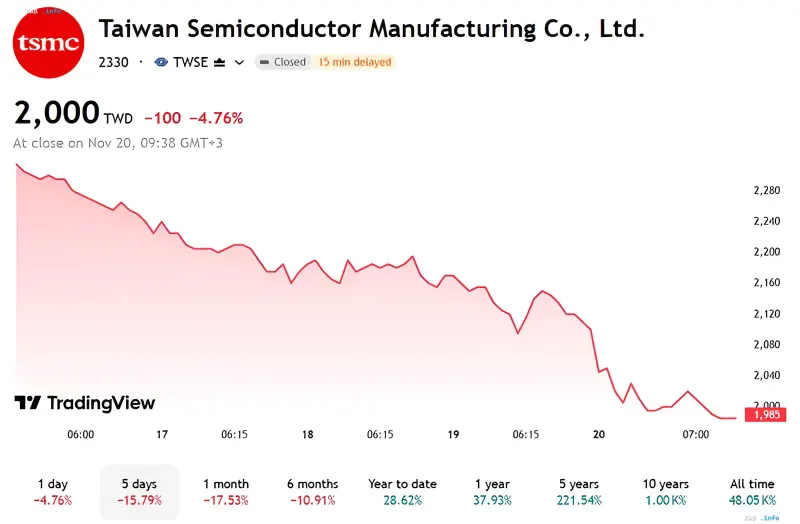
Shares of the world's largest contract semiconductor manufacturer, Taiwan Semiconductor Manufacturing Co. (TSMC), dropped by 4.8% on the Taiwan Stock Exchange (TWSE) on Friday, November 20, falling to 2,000 New Taiwan Dollars per share. This marks their lowest level in seven months. Over the trading week, the company lost 15.8% of its market value, recording its worst weekly performance since October 1997. The sell-off affected the entire semiconductor sector: Taiwan's TAIEX index fell by 17.5% for the week, its sharpest weekly decline since 1990, while the US Philadelphia Semiconductor Index (SOX) closed down 17.1%.
New US Export Rules Hit on Two Fronts
The primary trigger for the sell-off was the new regulations issued by the US Department of Commerce's Bureau of Industry and Security (BIS), which took effect on November 19. Washington has tightened controls on shipments of advanced accelerators to overseas data centers that, according to US regulators, provide Chinese companies with significant computing power for artificial intelligence tasks. The restrictions now also cover arrangements where the chips physically remain outside China while a Chinese customer accesses them remotely. Specific provisions directly affect contract manufacturing: simplified approval procedures that previously allowed a manufacturer to confirm that a finished chip's transistor count fell below a set threshold, thereby exempting it from stricter controls, have been eliminated for certain orders from Chinese developers.
TSMC Suspends Some Chinese Orders
As a result, the company has suspended Chinese orders for chip production using 16nm and more advanced process nodes pending US export licenses. For such clients, mainly 28nm and 40nm nodes remain available, provided the chips do not require HBM memory or advanced packaging. Consequently, TSMC finds itself under pressure from two sides: restrictions have already impacted some orders from China, while tighter rules for overseas data centers cast doubt on future demand for accelerators produced by the company for Nvidia and other developers. The scale of direct losses has not yet been disclosed.
High Stakes: Advanced Nodes Drive Revenue
The stakes are particularly high for TSMC: in the third quarter, process nodes of 7nm and below accounted for 79% of its wafer fabrication revenue. The company's latest financial report showed a 50.9% year-on-year increase in revenue and a 68.7% rise in net income in New Taiwan Dollars; at the time, TSMC stated that demand for advanced nodes would remain robust and planned to rapidly scale up 2-nanometer production. Friday's crash reflects market anxiety over future sales rather than past performance, as regulations are already reshaping access conditions to advanced chips and prompting investors to revise long-term forecasts.
Sell-Off Amid Cooling Interest in AI Assets
Washington's decrees coincided with a broader investor retreat from artificial intelligence-related stocks due to high valuations, rising debt, and doubts about the return on investment in data centers. On Friday, TSMC's industry peers also showed weak performance: MediaTek dropped by about 10%, and UMC by about 9%. Notably, even Nvidia's strong earnings report failed to halt the sell-off. The market is increasingly questioning whether current AI spending levels can be sustained and is shifting that risk onto chip manufacturers whose revenues heavily depend on advanced process nodes.