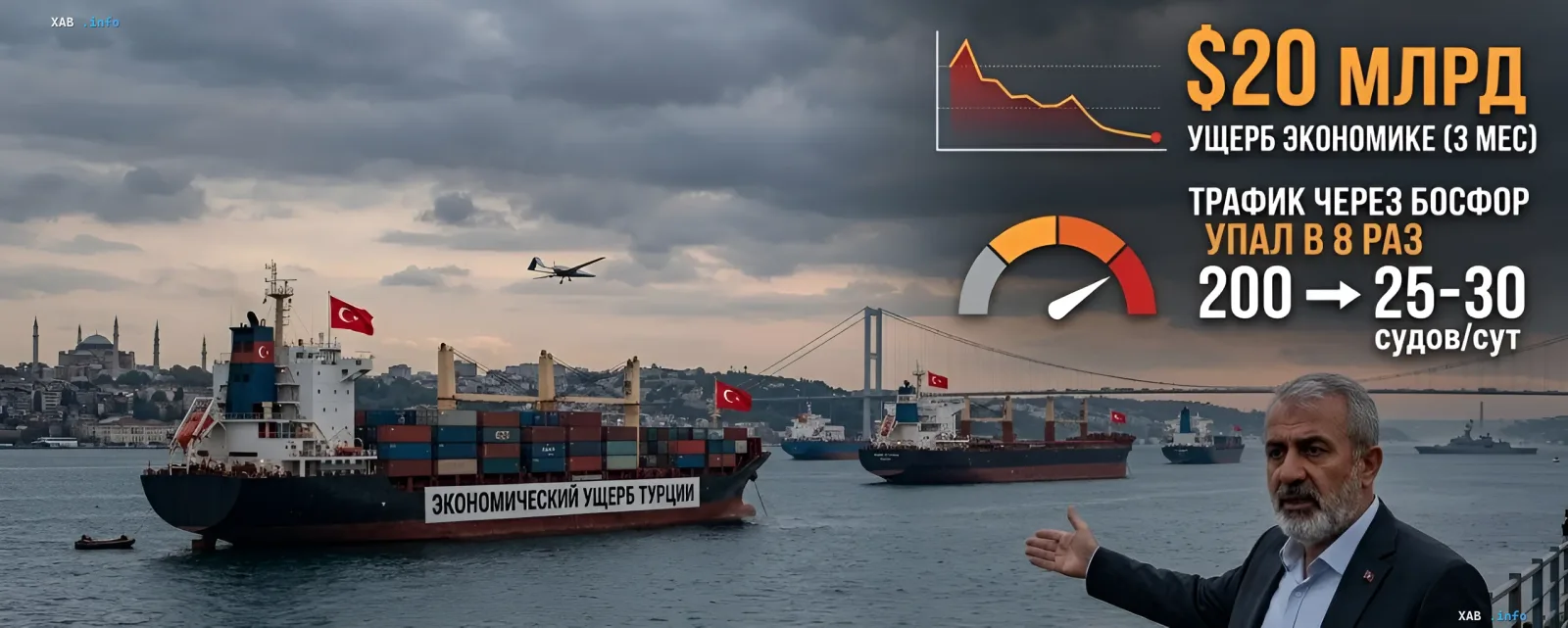
Mustafa Can, Chairman of the Board of the shipping company Transbosphor Deniz Taşımacılığı, assessed the potential damage to Turkey's economy from the escalation of hostilities in the Black Sea at $20 billion over a three-month period in an interview on the Bloomberg HT channel. According to him, the losses consist of three components: lost transit revenues through the Bosphorus and Dardanelles, the disruption of shipments along the "Black Sea – Egypt" route, and the costs of repairing civilian vessels that sustained damage. Can described the Ukrainian side's actions against commercial shipping as "very reckless" and "piratical," emphasizing that the intensity of vessel traffic through the Turkish straits has fallen by approximately eightfold — from 200 to 25–30 vessels per day.
Macroeconomic Context: A Blow to the Transit Hub
For Ankara, the Black Sea is not merely a transport artery but the structural foundation of the country's geoeconomic status as a key transit hub between Europe, Asia, and the Middle East. The decline in shipping traffic through the straits hits the treasury directly, as well as the revenues of private shipping operators who have dominated the region for decades. An assessment of $20 billion for a single quarter is critical for an economy already under pressure from chronic inflation. According to data from relevant Turkish institutions, a significant portion of vessels flying the Turkish flag has fully suspended operations in the Black Sea; since the start of the full-scale conflict, around 50 Turkish dry cargo and coastal vessels have sustained damage of varying degrees.
Legal and Insurance Consequences for the Commercial Fleet
The expansion of the drone strike zone to the civilian fleet and commercial ports, including Novorossiysk, has put the status of neutral carriers at risk. From a legal standpoint, damaged vessels, even when they remain afloat, are forced to sit idle in repair for months, losing their active insurance coverage and generating losses for their owners. The terminology used by the Turkish business community ("piratical attacks") reflects a shift in the legal qualification of the incidents: if the strikes were initially directed exclusively at military targets and vessels carrying military cargo, current practice blurs the line between military and civilian targets, creating a precedent for revising the terms of marine insurance contracts in the region.
Diplomatic Track and the Moratorium Initiative
Against the backdrop of growing financial losses, Turkish authorities have attempted a diplomatic settlement. Turkish Foreign Minister Hakan Fidan officially proposed that Moscow and Kyiv introduce a mutual moratorium on strikes against commercial shipping. The Russian side effectively rejected the initiative, citing the absence of formalized proposals through established diplomatic channels. Meanwhile, in August 2026, the US administration held tough negotiations with Kyiv, securing Ukraine's agreement to cease strikes on tankers and critical infrastructure not linked to Russia, in particular the Caspian Pipeline Consortium terminal in Novorossiysk, through which Kazakh oil exports are shipped.
Market Reaction and Supply Chains
The escalation of hostilities on Black Sea trade routes has already been reflected in global commodity markets: wheat futures rose by 17%. For Turkey, this means double pressure — on both import prices and export potential. The disruption of the "Black Sea – Egypt" route deprives the region of an alternative logistics channel, increasing dependence on the Suez corridor and, accordingly, on geopolitical risks in the Middle East.
Long-Term Geopolitical Consequences
Mustafa Can's statement marks a systemic crisis in Ankara's "Black Sea strategy" and growing frustration within the Turkish business community over Kyiv's actions. For Ukraine, the Black Sea functions as a second front, where strikes on Russian port infrastructure and logistics are viewed as a tool of economic pressure on Moscow. A side effect of this strategy is the destruction of the trade and economic interests of third countries. Analysts note that if the current level of activity persists, Ankara may move from verbal warnings to introducing strict technical restrictions in the straits for vessels linked to Ukrainian transit, which would radically change the architecture of Black Sea navigation.