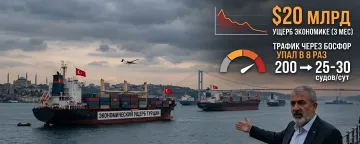
On August 8, 2026, an event occurred in the Black Sea region capable of significantly impacting global logistics chains. Turkey, which controls the strategic Bosphorus and Dardanelles straits, imposed restrictions on the movement of certain commercial vessels heading to the Black Sea. The reason for these measures was Ankara's concern regarding the increasing frequency of unmanned aerial vehicle (UAV) attacks on civilian vessels in the region.
Suspension of transit permits
According to sources familiar with the situation, the Turkish General Directorate of Coastal Security (Kıyı Güvenliği Genel Müdürlüğü) sent notifications to several vessels heading towards the Russian port of Novorossiysk. The messages stated a suspension of transit permit issuance or the need for additional time to thoroughly review applications for passage through the Dardanelles Strait. Novorossiysk is a critical hub for Russian oil and grain exports, and any delays here could have immediate consequences for global markets.
Information also indicates that restrictions may extend to vessels heading to Ukrainian ports. This creates uncertainty for participants in the grain trade, which is already under pressure due to the ongoing conflict. Official representatives of the Turkish authorities have not yet provided detailed explanations for their actions, limiting themselves to general statements about the need to ensure security.
Context: escalation of attacks on shipping
Ankara's decision comes against the backdrop of a sharp escalation of tensions in the Black Sea. Earlier this week, the Turkish Ministry of Foreign Affairs officially stated that a group of Turkish citizens had been injured as a result of drone attacks on two Turkish vessels. The ministry's statement contains a call for all warring parties to urgently take concrete measures to ensure the safety of shipping.
Turkish authorities warned that further escalation would have "multifaceted negative consequences," specifically highlighting risks to food security. This is not the first incident involving Turkish vessels: last month, a similar attack was carried out near the Caspian Pipeline Consortium (CPC) oil terminal in Novorossiysk. A series of strikes has repeatedly led to stoppages and resumption of loading, disrupting supply stability.
Impact on global trade and grain prices
Delays in the straits threaten to complicate global trade at a time when oil flows are already disrupted due to the war in Iran and reduced transport volumes through the Strait of Hormuz. The intensification of attacks in the Black Sea has raised serious concerns about grain supplies from the region. According to analysts, this became one of the factors contributing to the rise in wheat prices to a two-year high in July 2026.
However, according to ship tracking data collected by Bloomberg, the restrictions are selective. On Saturday, vessels continued to move north through the Dardanelles heading to Bulgarian, Romanian, Georgian, and Turkish ports. This indicates that Ankara is attempting to balance between ensuring security and complying with international obligations for free navigation.
Legal aspect: Montreux Convention
The legal basis for regulating the straits is the 1936 Montreux Convention. The document obliges Turkey to maintain freedom of navigation for merchant fleets even during wartime. Consequently, Ankara does not have the right to completely close the straits to Russian civilian vessels, which is confirmed by the current situation with partial restrictions. At the same time, at the very beginning of the full-scale invasion, Turkey invoked provisions of the convention to close the straits to warships of the warring parties.
Contradictory data
Currently, there are discrepancies in the details of the restrictions. On one hand, sources indicate a suspension of permit issuance for vessels heading to Novorossiysk and Ukraine. On the other hand, traffic monitoring data shows that movement to other ports in the region is not disrupted. There is no official comment from Turkish authorities, leaving room for interpretation: is this a temporary security measure or the beginning of a stricter policy of control over the straits.