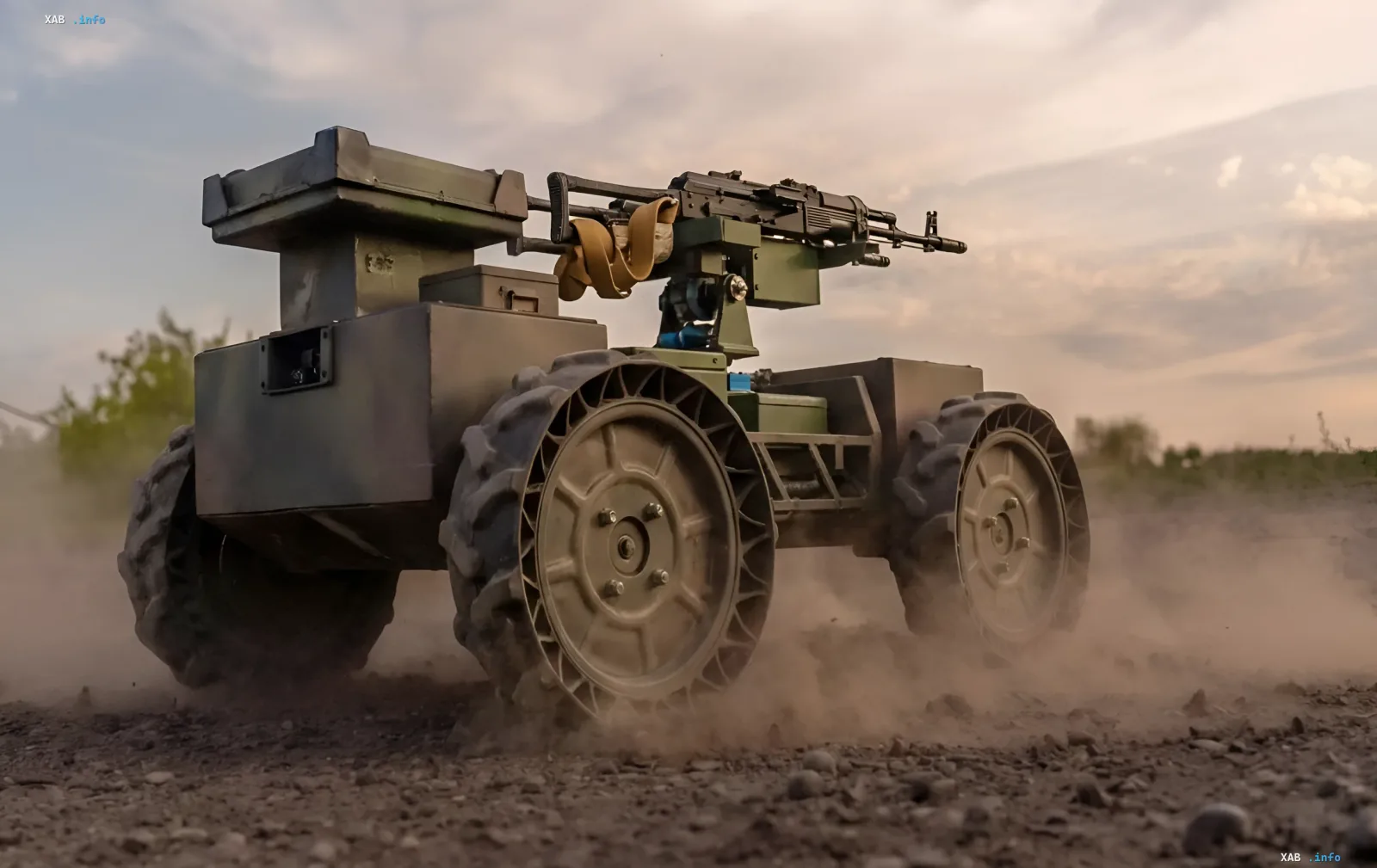
Units of the Defense Forces of Ukraine have begun combat testing of new strike ground robotic complexes equipped with turrets carrying Kalashnikov-system rifles. This was reported on August 28, 2026, by RBC-Ukraine, citing the press service of the Ministry of Defense. According to the ministry, these are specialized robotic turrets developed to the technical specifications of the Brave1 defense innovation cluster. The project received grant funding, and from the formulation of the task to the creation of a finished prototype, developers needed less than six months — a record-short timeframe for a defense development of this level.
Chassis architecture and fire module
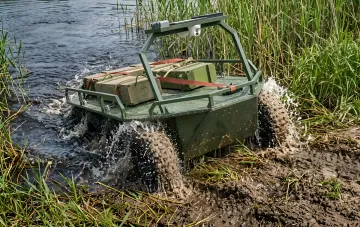
The complex is built on a four-wheel chassis with airless tires and a protected hull. According to the developers, this design provides resistance to debris, shrapnel, and punctures, and also allows maneuvering in complex cross-country terrain without the risk of losing the running gear. The fire module is a paired turret that allows mounting two Kalashnikov-system rifles at once — the most widely used small arms in the Ukrainian army. In the developers' assessment, this significantly increases the density of fire during assault and defensive operations against enemy infantry. At the same time, the turret is modular and can be installed on other wheeled and tracked ground robotic complexes, expanding the range of carriers.
Economic logic and scaling
The key engineering decision, according to Brave1 representatives, was the use of standard-issue Kalashnikov rifles instead of specialized machine guns or small-caliber cannons. This allows significantly reducing production costs, simplifying ammunition logistics, and rapidly scaling the deployment of strike UGVs at the front. The Kalashnikov rifle remains the basic small arm of the army, which means a virtually unlimited stock of ammunition and no need to create a separate supply system for the robots.
Combat use and confirmed results
Several units of the Defense Forces are already testing the new systems in real combat conditions. The Ministry of Defense press service confirmed cases of successful use of UGVs against enemy ambushes with "ambush" drones — so-called FPV unmanned aerial vehicles that are buried in the ground and detonate when the target approaches. Using a robot in such scenarios reduces personnel casualties during mine clearance and position sweeps. According to the ministry, since the beginning of 2026, ground robotic complexes overall have completed more than 100,000 tasks in place of Ukrainian soldiers at the front, indicating a systematic rather than experimental nature of their use.
Context: international development of ground robotics
The Ukrainian development fits the global trend of mass deployment of ground unmanned platforms. Earlier, the Turkish defense company FNSS presented a new amphibious UGV, the U-MAV (Multi-Purpose Modular Unmanned Amphibious Vehicle), capable of reaching a speed of up to 7 knots on water and up to 70 km/h on land. In Ukraine, the emphasis is on rapid production and modularity: it was recently reported that the Protector UGV doubled its payload capacity and received a new type of communication. In parallel, according to Belarusian media, the production of Ukrainian ground drones on the territory of Denmark is being discussed, which could become an additional channel for scaling.
Contradictory data
No significant discrepancies in figures and dates between sources were found in the provided materials. The only nuance: the Ministry of Defense press release mentions a "paired turret" for two rifles, whereas in the photo published by RBC-Ukraine the complex is shown with a single installed barrel. Developers explain that the turret is structurally designed for two rifles, however, at the stage of initial field trials, some machines may be operated with a single barrel. Thus, this is not a contradiction in facts, but a difference between the design configuration and the current state of the specific prototype in the photo.