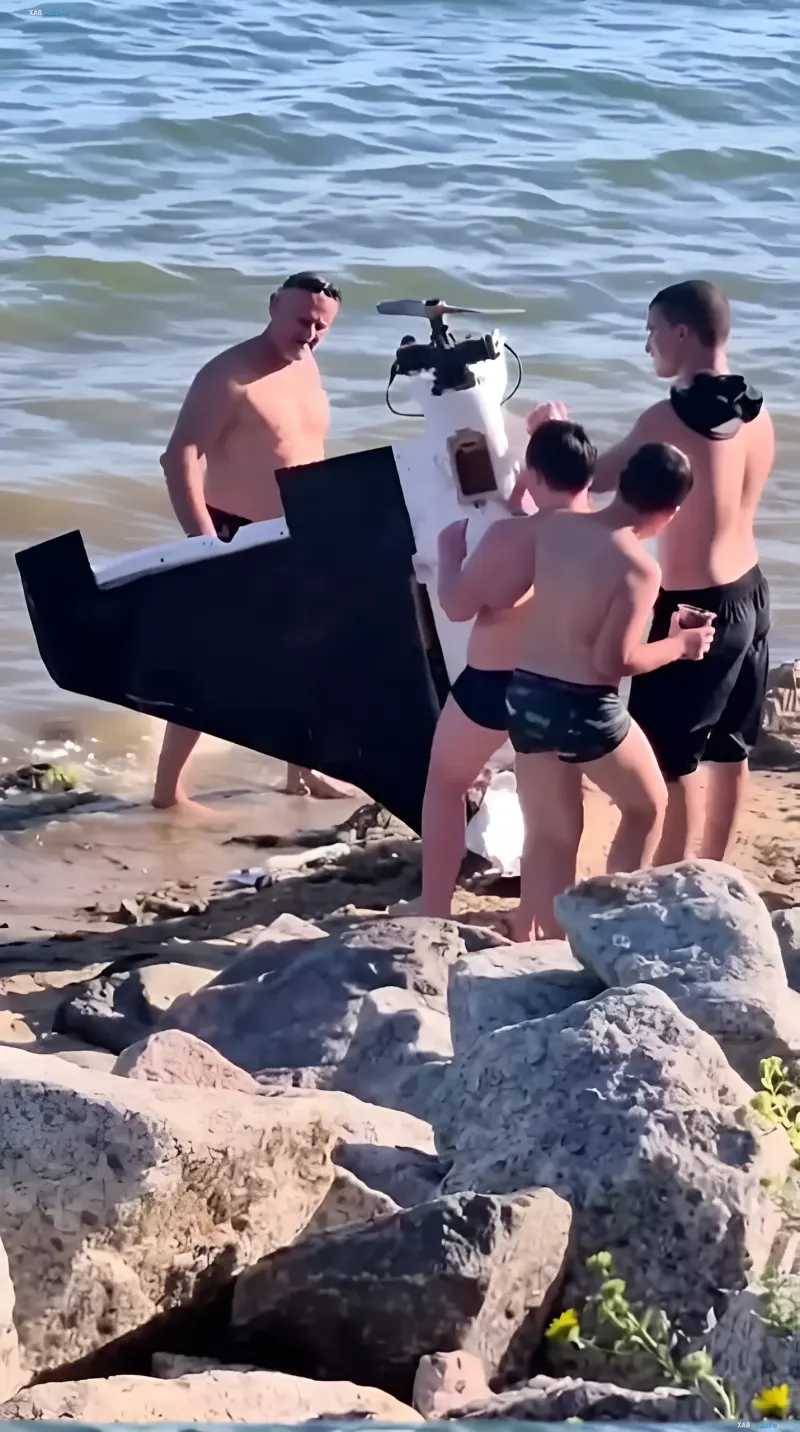
On August 1, 2026, a video recording documenting an incident on the Odessa coast appeared on social media. The footage shows a group of civilians, including minors, retrieving and moving fragments of an unmanned aerial vehicle (UAV) from the water. The video sparked a wide resonance and highlighted the importance of adhering to safety regulations when discovering explosive objects during martial law.
According to visual information obtained from the video recording, the find was made in shallow water near a stone-reinforced shoreline. The object appears to be debris of a dark gray aircraft. The footage records physical contact by people with structural elements, including wing fragments made of composite materials and a power unit with a propeller.
Safety experts note that such finds carry hidden threats that are not always obvious at first glance:
- Power unit: Internal combustion engines may contain fuel residues capable of detonation, as well as unexploded charges.
- Fuselage elements: Toxic chemical compounds may be present in the composite materials of the wings, and structural deformation sometimes indicates the presence of detonators.
- Internal compartments: Closed cavities of the hull often conceal warheads or non-contact mechanisms that may activate upon moving the object.
At present, no official comments have been received from the State Emergency Service of Ukraine (SES), the National Police, or the Southern Operational Command regarding the modification of the detected aircraft and the circumstances of its fall into the water area. However, current instructions clearly regulate the order of actions for citizens in such situations.
According to the norms of the legal regime of martial law, any detected UAV or its fragments are a priori classified as potentially dangerous objects. Relevant departments prescribe the following algorithm of actions when discovering such items:
First, it is strictly forbidden to touch, move, lift, or disassemble structures. Second, it is necessary to immediately move to a safe distance — no less than 100 meters — and restrict access of other persons to the place of discovery. Third, one must immediately report the find to emergency services by calling "101" (SES) or "102" (National Police), specifying the exact geolocation.
Official departments have repeatedly emphasized that shot down or fallen drones may contain explosives with delayed detonation, electric detonators, or elements that react to changes in spatial position. The cleaning of territories and water areas, as well as the identification of object types, is carried out exclusively by certified explosives experts and sapper units.