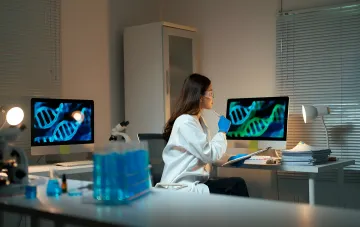
Researchers at the University of California, San Diego (USA) have reported a significant breakthrough in genetics: using artificial intelligence algorithms, they managed to decode the so-called start (initial) sequence of human DNA. According to the authors, the results of the work have been published in the scientific journal Genes and Development. In their assessment, the discovery opens up the possibility of more accurately predicting the risk of developing cancer and a number of other complex genetic diseases at a very early stage — long before the appearance of clinical symptoms.
What Is the “Start Sequence” and Why Does It Matter
For the normal development and growth of an organism, the precise functioning of tens of thousands of genes is critically important. Inside cells, DNA segments coordinate genetic sequences, ensuring the production of enzymes, hormones, and proteins on which biological functions depend. If these genes are activated incorrectly, cells may stop working normally or turn into malignant tumors. This is precisely why understanding how and when a gene “switches on” is considered one of the key questions in modern molecular biology.
How AI Analyzed Half a Million Promoter Variants
To determine the mechanism of gene switching, the research team focused on analyzing the promoter region of DNA — the segment considered the starting point where the gene’s coding instructions are first converted into functional cellular products. The work was led by graduate student Torri Rhine-Carrigg and Professor James T. Cadonagi. The combination of high-throughput DNA sequencing and machine learning algorithms made it possible to analyze data on approximately 500,000 promoter region variants. Trained on this large dataset, the AI model identified the characteristic pattern of the start sequence and established that this region is present in approximately 60% of all human genes.
From Decoding the Code to Cancer Prediction and Gene Therapy
According to Professor James T. Cadonagi, for the first time it has been demonstrated that such AI models possess powerful predictive capabilities regarding the presence or absence of a start sequence in human genes, and they successfully decoded the structure of the DNA base sequence of this region. Determining this mechanism, in the authors’ assessment, lays the foundation for analyzing the impact of even the most minor mutations, which are one of the main causes of cancer and many genetic defects. In addition to diagnostics, the data obtained make it possible to create artificial DNA segments capable of switching genes on and off on command, which promises to become a tool for gene therapy to correct defective sections of code before diseases arise.
Significance for the Medicine of the Future and Source Caveats
The authors describe this result as a major shift that combines laboratory experiments with artificial intelligence to understand the human genetic code: in every cell, containing about 6 billion DNA bases, there is a unique gene expression code that determines when and how active each gene is. Decoding the origin region, they say, is the first step toward creating a comprehensive AI model for the entire genetic code, capable of predicting and preventing diseases. At the same time, it should be noted that in the Russian-language presentation of the material (a translation of Vietnamese media outlets), the specific publication date in Genes and Development and the exact spelling of the authors’ names are not consistently provided, and additional news sources on the topic of “AI and oncology” relate to other, unrelated studies; therefore, the factual details rely predominantly on a single translated source.