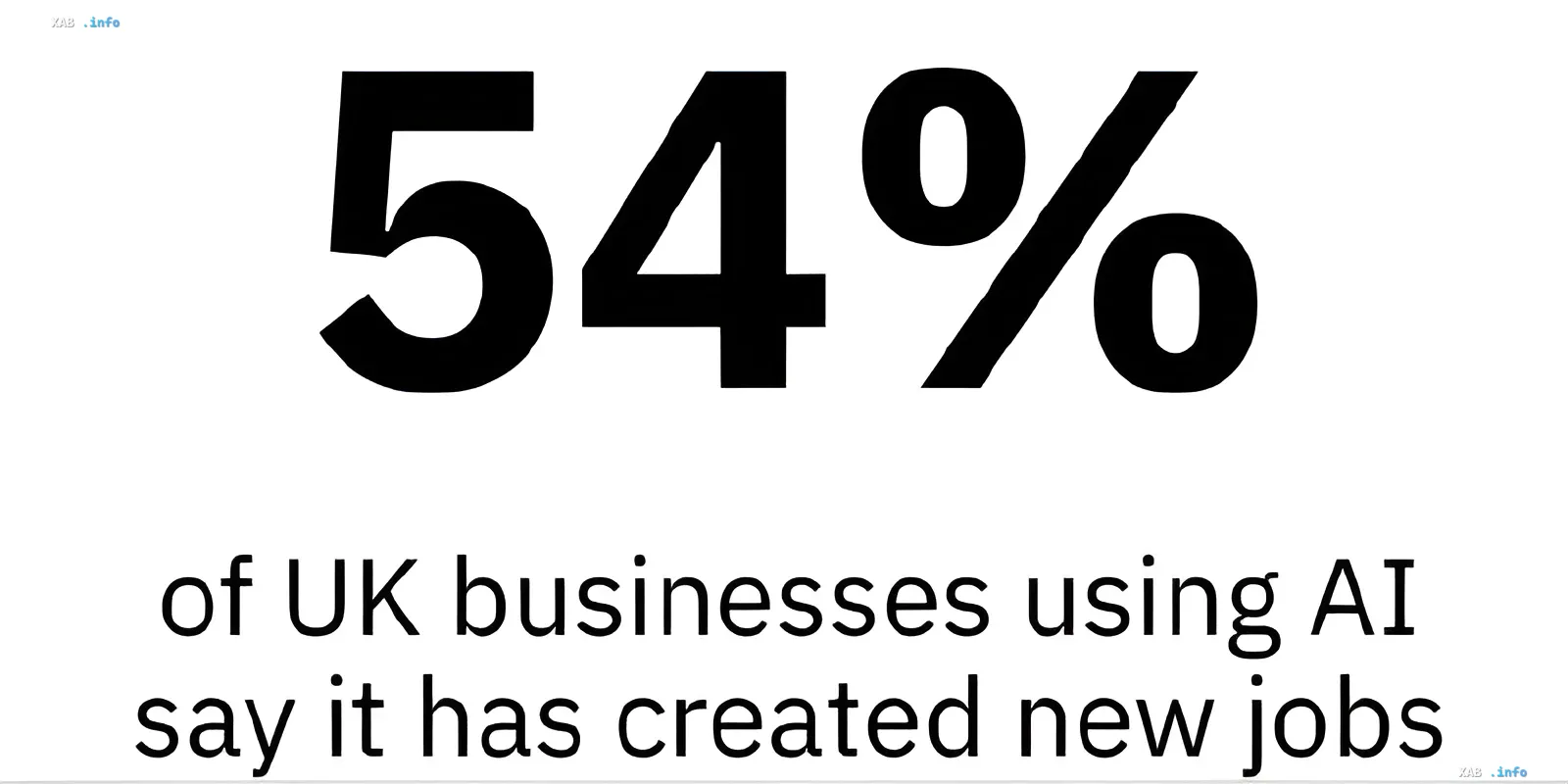
An official report by the financial conglomerate Lloyds Banking Group, prepared based on the large-scale Lloyds Bank Business Barometer survey covering 1,200 UK companies, recorded a result that came as a surprise to the public: the adoption of artificial intelligence technologies has led to the creation of new jobs in 54% of the organisations surveyed — from small businesses to large corporations. For context: 61% of businesses in the UK already use generative and applied AI in their operational activities. These figures directly refute the entrenched apocalyptic predictions of mass unemployment and force a reassessment of the economic risks associated with automation.
Automation psychosis: the gap between fear and reality
The published figures have exposed a deep cognitive dissonance between real business practice and the mass sentiments of employed workers. According to a parallel study by King's College London, 69% of Britons experience constant anxiety over the risk of losing their jobs to neural networks, and 57% of the population believe that technology will destroy more jobs than it creates. The pressure of fear is so great that one in five residents of the United Kingdom (20%) seriously predicts a wave of civil unrest and social riots on the grounds of "technological unemployment." Lloyds analysts emphasise, however, that the tectonic shift in the labour market lies not in mass layoffs, but in a change in the very structure of employment.
Not dismissal, but transformation: a "two-speed labour market" is taking shape
The reality recorded in the report shows that the economy is not experiencing the "death of professions," but a large-scale requalification. In 21% of companies, specialised AI-specific roles have been created, and 24–25% of employers give priority to candidates with skills in working with artificial intelligence when hiring. AI takes over routine tasks — data entry, basic analytics, primary auditing — but in return demands algorithm operators, data annotators, prompt engineers, and AI cybersecurity specialists. Meanwhile, industry agencies and PwC experts point to the formation of a "two-speed labour market": demand for AI-skilled specialists is growing, while positions involving routine tasks are being optimised.
The market's ultimatum and investment in people
For modern business, refusing artificial intelligence has become synonymous with commercial failure: 60% of business leaders stated outright that ignoring AI tools will inevitably lead to a loss of competitiveness and displacement from the market. Instead of mass layoffs of existing staff, British capital has taken the path of pragmatic adaptation — 58% of employers have budgeted a significant increase in spending on training and upskilling of current employees in the AI field over the coming year. It is cheaper for business to train a loyal specialist in basic skills for interacting with neural networks than to search for scarce and expensive talent on the external market.
Analytical conclusion: the main threat is the unwillingness to learn
The Lloyds report clearly demonstrates that Luddite fears of AI are greatly exaggerated: we are observing a classic process of "creative destruction" à la Schumpeter, in which dying economic models give way to more efficient ones. The key takeaway for a worker in 2026 is that the main threat comes not from artificial intelligence itself, but from the unwillingness to requalify. AI is unlikely to replace a human, but a specialist working in tandem with neural networks will guaranteed outperform one who does not use them. Thus, the main challenge for the state shifts from combating unemployment to creating flexible systems of continuous education capable of rapidly adapting millions of specialists to new technological realities.