The UK Home Office has announced that the country has recorded its highest level of deportations since 2016. According to official figures from the department, more than 80,000 people have left British territory since the 2024 parliamentary elections. This represents a 52% increase compared to the figure two years prior to the elections, which the government assesses as evidence of significantly strengthened migration control and the effectiveness of immigration services.
A decade-long record: what the figures say
As emphasized by the Home Office, the current volume of removals is the highest in the last decade — since 2016. In its announcement materials, the department used the phrasing 'nearly 100,000' deportees, whereas the official statement cites a more precise figure of 'more than 80,000 people'. Both indicators point to the same historical maximum, although the difference in phrasing reflects the gap between the preliminary announcement and the final statistics.
Home Secretary's position and legislative plans
Home Secretary Shabana Mahmood described these figures as a 'clear signal': London is prepared to accept those arriving legally and to return those who arrived illegally or violate the law. According to her, much more work remains to be done; therefore, the government is pushing for the adoption of new legislation that will allow for the faster expulsion of individuals illegally present in the country. Furthermore, the department intends to double the funding for immigration enforcement groups by 2028.
Context: migration crisis off the coast of Spain and in Ceuta
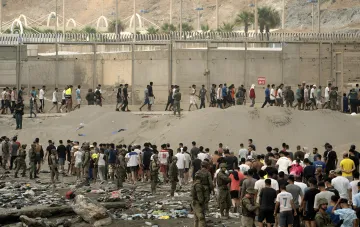
The statement was made against the backdrop of a worsening migration situation in the western Mediterranean. According to media reports, on August 19, around 60 migrants reached mainland Spain again: a boat carrying people approached the coast in the province of Murcia, near La Manga Club. Earlier, in the enclave of Ceuta, hundreds of migrants staged a protest on a city beach, demanding asylum in Spain; among them were individuals stranded in the enclave after a mass breach of the border a few weeks prior. These events underscore that the issue of illegal migration remains one of the key priorities for European security policy.
Contradictory data
Fact-checking revealed two discrepancies that are important to note. First, the announcement used the estimate of 'nearly 100,000' deportees, while the official Home Office statement cites the figure 'more than 80,000 people' — this is a difference in phrasing rather than substance, but it could be misleading when cited. Second, the original source contained incomplete lists: the sections 'among those deported are' and 'of the total number of deportations' were left without specific categories and proportions. Consequently, the precise breakdown of removed individuals by category (e.g., by country of origin or grounds) is not confirmed in the provided data and is not included in this article to avoid inaccuracies.