

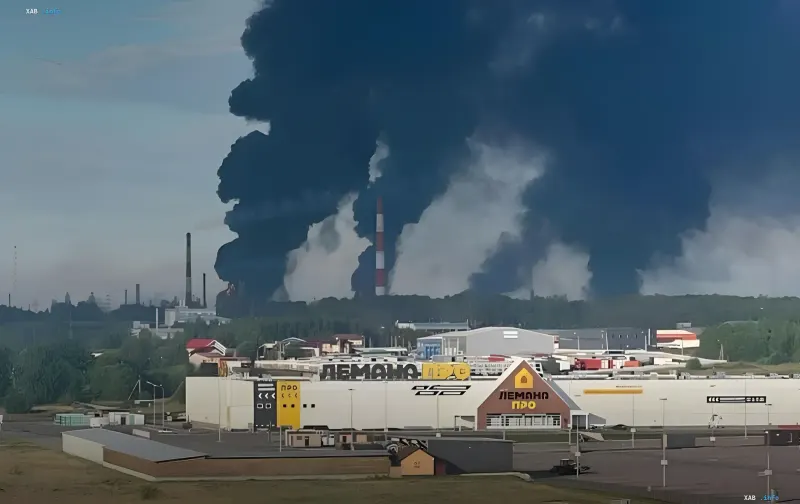
August 14, 2026. The situation regarding fuel supply in the Russian Federation has reached a critical point. Since the beginning of the current month, Ukrainian unmanned aerial vehicles (UAVs) have struck a dozen major oil refineries (ORs), which accounts for nearly a third of the total operating capacity in the aggressor state. As monitoring data and public reports indicate, the resumption of intense attacks has led to a systemic disruption of supplies and a sharp rise in fuel prices.
Scale of Destruction: Strike on Infrastructure
Analysts have calculated that since the beginning of August, Ukraine has struck 10 out of 34 major Russian oil refineries. Most of these facilities had already been attacked earlier in 2026, however, the current wave of strikes has proven to be the most destructive. In particular, one of the country's largest refineries has completely ceased operations following a massive fire caused by a drone attack. Experts estimate the recovery time for damaged equipment to be at least six months, which effectively takes a significant share of refining capacity out of circulation for an indefinite period.
Economic Consequences and Imports from India
The fuel shortage, caused by a series of successful strikes by the Ukrainian Defense Forces, has forced Moscow to take unprecedented measures. The aggressor state has begun importing gasoline from India to compensate for the drop in domestic production. Logistics companies operating within Russia are already reducing transport routes and significantly increasing tariffs, which exacerbates the crisis. According to RBC-Ukraine, the fuel crisis has taken on a large-scale character, paralyzing operations in several regions and creating a threat to economic stability.
Political Risk Ahead of Elections
The agency notes that the current situation creates a serious political problem for the Kremlin. On the eve of parliamentary elections scheduled for next month, a sharp spike in fuel prices and gasoline shortages could become a catalyst for social discontent. Strikes on refineries associated with the largest oil producers in the Russian Federation hit not only the economy but also the image of the authorities, demonstrating the vulnerability of strategic objects in the face of Ukrainian asymmetric warfare.
Contradictory Data
There are discrepancies in the assessment of damage and the reasons for the shutdown of plants. Official Russian sources tend to downplay the scale of the attacks, claiming that most damage is local in nature and does not affect overall refining volumes. At the same time, independent observers and Ukrainian military sources insist that many facilities have been completely disabled. In particular, information about the complete shutdown of one of the largest refineries is confirmed by visual materials and fire reports, although data on the exact recovery time remains vague.
New Targets: Strike on Gazprom Neftkhim Salavat
In the night of August 13, the Ukrainian Defense Forces struck the Gazprom Neftkhim Salavat oil refining complex in the Republic of Bashkortostan. This confirms that the Ukrainian side is expanding the geography of strikes, covering not only the European part of Russia but also strategically important objects in the Volga region and the Urals. An attack on this complex, which is a key element of the supply chain, could lead to an even greater shortage of oil products in the central part of the country.