
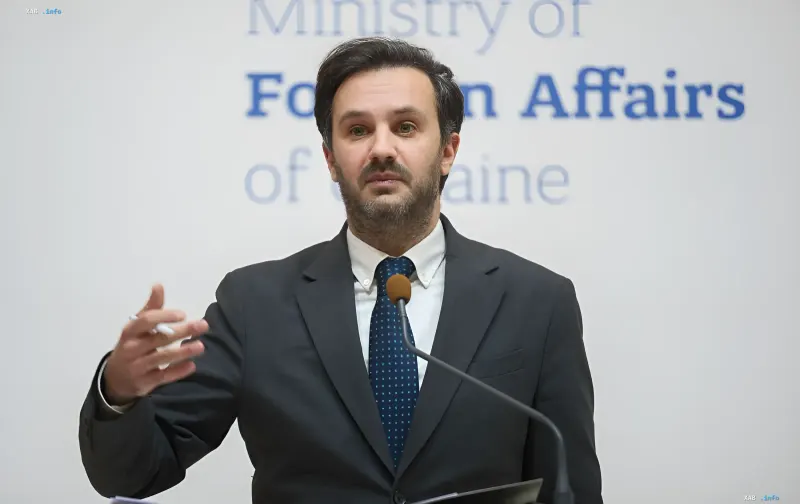
Ukraine is preparing to move from building the legal framework to the practical launch of the Special Tribunal on the Crime of Aggression by Russia against Ukraine. This was stated by Georgiy Tikhii, spokesperson for the Ministry of Foreign Affairs of Ukraine, at a briefing, emphasizing that the core legal architecture has already been created and that in 2027 the focus should shift to its real-world implementation. According to him, work in this direction is being carried out by the Department of International Law of the MFA under the leadership of Anton Korinevych.
From Legal Architecture to Real Justice: A Course Set for 2027
"2027 must be the year of the transition from creating the legal architecture — and it has been created over this period — to real justice," Tikhii stated. This refers to the operational launch of both the Special Tribunal itself and the International Compensation Commission for Ukraine. The ministry emphasizes that, at present, Kyiv is working with the capitals of partner countries to complete the necessary domestic procedures for participation in the tribunal's launch mechanism. The basis is a special extended partial agreement, which was previously approved and signed in Chișinău.
International Participation: 36 Council of Europe Countries and Beyond
As of September 2026, 36 member states of the Council of Europe, as well as the European Union, Australia, and Costa Rica, have expressed their intention to accede to the framework partial agreement. Four countries — Lithuania, Estonia, Norway, and Sweden — have already completed the necessary domestic procedures. Ukraine, in turn, must also ratify the relevant agreement: the MFA has already prepared and submitted the required package of documents for accession.
Financial Model: A Realistic and Predictable Budget
In parallel with the legal issues, Kyiv is working on the financial component of the future institution. Negotiations are ongoing with states that contribute to the Council of Europe's budget, as well as with the Netherlands and the European Union. The MFA notes that the tribunal's budget must be realistic and predictable, provide for multi-year planning, and take into account Ukraine's special status as a state that has become a victim of aggression. "Right now, very practical work is being done on this special tribunal's budget," Tikhii noted.
Personnel Changes Will Not Halt the Process
A separate issue at the briefing concerned a possible pause in the establishment of the tribunal following the departure of Iryna Moudra, who had long been dealing with the issue of Russia's international responsibility. Tikhii assured that no such pause would occur: part of the relevant functions is being taken over by the MFA's Department of International Law. "This work continues, and it is not focused on personnel; it is, after all, systemic," the spokesperson emphasized, adding that Ukraine is carrying out this work as a state, and therefore personnel reshuffles should not lead to a loss of momentum.
Context: The Council of Europe Decision and the Choice of The Hague
A key stage in the tribunal's launch procedure was the meeting of the Committee of Ministers of the Council of Europe on May 15, at which the decision on the mechanism for establishing the Special Tribunal on the Crime of Aggression by Russia against Ukraine was approved. Ukrainian Foreign Minister Andrii Sybiha stated that Kyiv had received official confirmation of the tribunal's location: the Netherlands confirmed that it will be based in The Hague.




