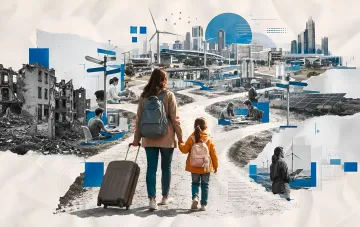

Against the backdrop of the ongoing military conflict, Ukraine is facing growing pressure on its labor market, which, according to demographers, could become a long-term structural problem. In an interview with RBC-Ukraine, Alexei Poznyak, a senior researcher at the M.V. Ptukha Institute of Demography and Social Studies of the National Academy of Sciences of Ukraine and a candidate of economic sciences, stated that the key factor here is the duration of the war: the longer it lasts, the fewer Ukrainian citizens abroad will be willing to return home. In his words, most Ukrainian refugees are currently planning to stay in the countries that have taken them in, although these attitudes, the expert notes, may change depending on the dynamics of the situation at the front and within the country.
Demigration as a long-term demographic risk
Poznyak emphasizes that the presence of a significant portion of the population abroad already has noticeable economic consequences for Ukraine today. The expert directly links the protracted nature of the conflict to the deterioration of the demographic situation: each additional period of war reduces the likelihood of a mass return and, as a result, cements the loss of labor force. This means that even after hostilities cease, the country will not be able to automatically restore the pre-war level of employment — part of the labor resources, the researcher forecasts, will remain abroad for an indefinite period.
Labor shortage is already being felt in the market
According to Poznyak, a shortage of specialists is already being felt in many industries: "Right now, there is a shortage of many specialists in many fields." At the same time, the expert notes that after the war ends, the demand for workers may increase even further — primarily due to post-war reconstruction tasks and the expected investments from partner countries, which will require additional labor. "For now, compared to the pre-war period, we have a shortage in the labor market," he summarized, pointing out that the problem is not temporary but systemic.
Where Ukraine will attract migrants from
To compensate for the labor shortage, Ukraine, according to the expert's assessment, will have to attract labor migrants from other countries, although the choice of labor suppliers will be limited. Poznyak forecasts that the mass influx will come predominantly from economically poorer states — primarily from countries in Asia and Africa. Citizens of wealthy countries, he says, may come to Ukraine, but mainly as individual narrow specialists, not as a mass workforce. In the accessible version of the interview, the expert also outlined three main directions that could help compensate for the shortage of workers, however their detailed list is not disclosed in the provided materials, so the publication does not enumerate them in order to avoid inaccuracies.
Tolerance policy as a condition for integration
A key practical conclusion from the expert is the need to build a policy of tolerance toward migrants in advance. Poznyak proposes conducting social campaigns and informational events explaining the importance of respect for representatives of other cultures, in order to reduce the risks of conflicts over cultural differences. This thesis is consistent with the broader discourse that migration without integration does not solve the labor shortage problem but merely shifts it to the social plane.
Context: regulator confirms labor market problems
Poznyak's assessment fits into the overall picture recorded by other market participants. It was previously reported that the Ukrainian labor market has already faced a labor shortage due to the war and the departure of a significant number of citizens abroad, and that after the war the demand for workers may increase even further due to economic recovery. The National Bank of Ukraine also pointed to structural problems in the labor market, including the need to adjust wage levels. At the same time, as noted, after the start of the full-scale war, millions of Ukrainians left the country, although no new mass wave of migration is currently being recorded; at the same time, intensified shelling may affect people's decisions about leaving and returning to Ukraine.