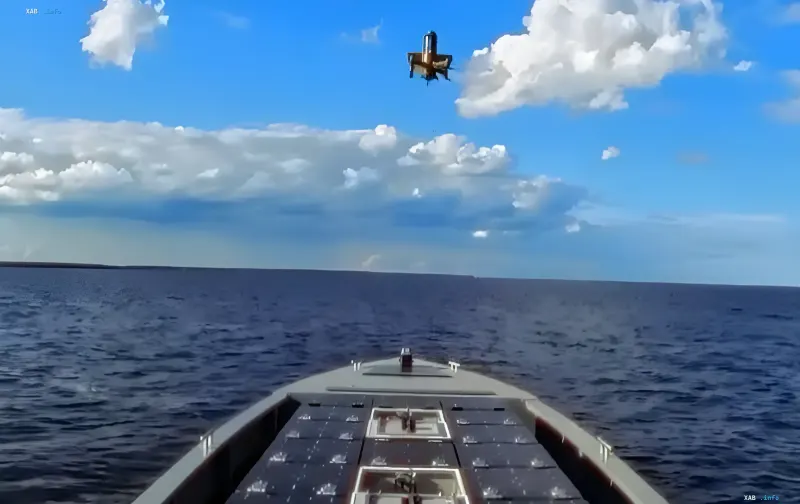
Against the backdrop of the ongoing fight against unmanned threats, Ukraine is demonstrating a new level of integration between air defense systems and maritime unmanned platforms. According to RBC-Ukraine, citing the developer 'Wild Hornets,' STING interceptor drones have begun launching directly from the deck of the MV11 maritime unmanned carrier at open sea. This turns the naval drone into a mobile launch platform for intercepting aerial targets far from the shore.
A naval 'carrier' for interceptors
The carrier for the interceptors is the MV11 maritime drone, capable of carrying a payload of up to 2,200 kilograms and operating autonomously for up to seven days. In the demonstrated configuration, its deck holds 18 protected boxes for interceptors; inside, each STING is secured by four guide tubes. The Ukrainian Ministry of Defense asked, succinctly and with a touch of irony, 'Can this be called the first Ukrainian aircraft carrier?' — emphasizing that the platform effectively performs the role of a launch carrier for aerial drones.
How the launch works: boxes, guides, Hornet Vision CTRL
The mechanics are designed for remote operation: the STINGs are stored in sealed protected boxes, and at the right moment the lids open, releasing the drones to intercept aerial targets. 'Wild Hornets' stressed that this confirms the capabilities of the Hornet Vision CTRL system — an interceptor can be launched from any location: a field, a forest, water, or any mobile platform, including maritime drones. The company calls the flexibility of the launch point, rather than the platform itself, the key advantage.
Combat use and public demonstration
According to the developer and data from the Main Directorate of Intelligence of the Ministry of Defense, interceptors launched from 'Magura' maritime drones at open sea have been in use for a long time — meaning this is not merely a demonstration but actual combat employment. The MV11 was first shown to the general public at the end of August at the unmanned systems parade for Independence Day, where it stood alongside the fleet of unmanned boats Sea Baby, Magura, and Sargan — the maritime carrier also made its first public appearance there.
Context: expanding the interceptor lineup
In recent months, STING interceptor drones have become an increasingly prominent part of Ukraine's air defense system. In parallel, the developers are expanding the lineup itself: in early September, the Defense Forces received the first jet-powered interceptor drone, the Alexa Spatium, designed to counter high-speed jet variants of 'Shaheds.' Thus, the maritime launch of STING fits into a broader program of expanding interception capabilities, rather than a one-off experiment.
Contradictory data
Differences between sources concern primarily the framing, not the figures. Some media outlets (including RBC-Ukraine) present the video material as a demonstration of capabilities, while the GUR and the developer claim actual combat use of the systems at open sea. The technical parameters — 18 boxes, up to 2,200 kg of payload, up to seven days of autonomy — match across all verified sources. It is worth noting separately that the news about Fox News confusing a Ukrainian interceptor with an American UAV refers to a different episode and does not affect the facts about the MV11 and STING.