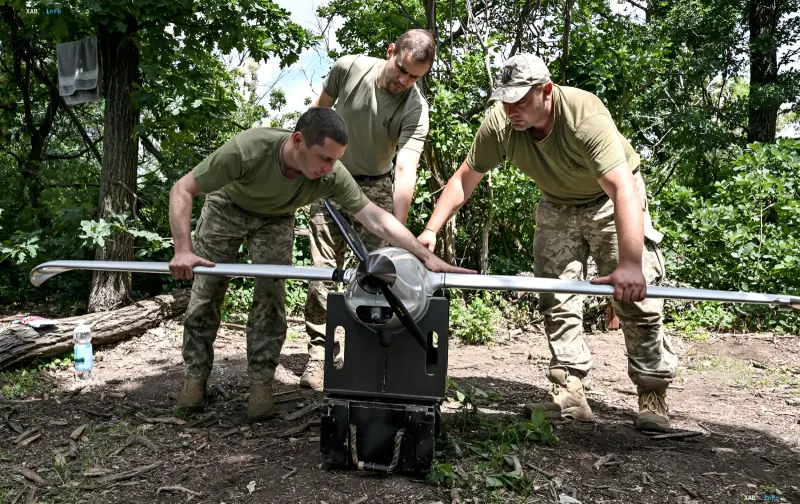
According to unmanned systems manufacturers, the Ukrainian reconnaissance system has established two main classes of reconnaissance drones: airplane-type vehicles, commonly known in the military as "wings," and multicopters. As noted by Atlon Avia, TAF Industries, and Vyriy Industries, these platforms do not compete but mutually complement each other: each type covers its own tactical niche scenario. Therefore, experts say, the question is not which device is "better," but how to properly combine them depending on the mission, range, and operational conditions.
Copters: Mobility, Hovering, and Tactical Flexibility
The Development Director of Atlon Avia called the key advantages of multirotor UAVs—commonly referred to as "Mavic-like"—rapid deployment, vertical takeoff and landing, the ability to hover over a target, and operating from restricted sites. These characteristics make copters especially in demand for close reconnaissance and detailed surveys of enemy positions. Eduard Lysenko, CBDO of Vyriy Industries, specified that copters are designed for tactical reconnaissance at a distance of up to 20 kilometers from the frontline—a metric he says the company's new Slavic reconnaissance drone should provide, while other devices in this class operate within a 10-kilometer radius. Lysenko named the ability to hover and stable operation in complex weather conditions, particularly under low cloud cover, as additional advantages of multicopters.
Aerodynamics Decide: Why "Wings" Fly Longer and Further
TAF Industries explained the difference in flight duration through aerodynamics. Multirotor systems spend the bulk of their battery energy not on forward movement, but on keeping their own mass suspended in the air. Due to the lack of aerodynamic gliding, copters have shorter flight times and cannot operate over long distances. Airplane-type UAVs, by contrast, utilize wing lift and expend energy primarily on maintaining speed, which provides them with significantly greater range and flight duration. However, "wings" also have limitations: stricter requirements are placed on launch and landing conditions, while the ability to hover and observe a stationary object in detail is substantially restricted. To keep the camera on a target, the device must constantly circle around it, requiring the installation of gyro-stabilized gimbals.
Hybrid VTOLs: A Compromise That Has Not Yet Paid Off
Hybrid solutions—vertical takeoff and landing (VTOL) vehicles—theoretically solve the problem of launching without a catapult by combining the advantages of both types. Nevertheless, TAF Industries considers such systems too expensive for mass deployment under conditions where the enemy actively uses interceptors. The high unit cost makes them economically unfeasible given the scale of losses typical of modern drone warfare. According to Lysenko's assessment, "wings" can carry high-performance cameras, but due to their size and flight characteristics, they are easier to detect and shoot down, further reducing the appeal of expensive hybrid platforms.
Dependence on "Mavics" and the Path to an Indigenous Multirotor Solution
Eduard Lysenko emphasized that Ukrainian manufacturers need to create their own multirotor reconnaissance drone without being tied to the "Mavic" brand. In his opinion, such a device must be mass-produced, easy to operate, and not require lengthy pilot retraining. Lysenko pointed to a number of problems associated with procuring Chinese "Mavics": dependence on a single type of equipment, market shortages, and the risk of export restrictions or complete bans from the PRC. Creating a domestic platform, he said, will remove these risks and ensure stable supplies for reconnaissance units.
Thus, the Ukrainian UAV industry is building a multi-layered reconnaissance system in which multicopters cover the close tactical contour, while airplane-type vehicles provide long-term surveillance reconnaissance over large territories. Future development, experts note, will be tied to creating their own mass-market platforms and reducing dependence on imported components.