Ukraine's defense industry has turned the 'Bogdanka' self-propelled artillery system (SPH) from a one-off development into mass serial production: according to the RBC-Ukraine special project 'Our Own Weapons — The Shield of Independence. How Ukraine Rebuilt Its Defense Industry,' output has reached 40 units per month. At the start of the full-scale invasion, the country had only a single example of the system, but by October 2025, as President Volodymyr Zelensky stated, the monthly output had doubled compared to the previous year and reached 40 SPHs. Today, the 'Bogdanka' is considered one of the largest serial production lines in Europe for 155-mm self-propelled artillery and a symbol of the transformation of the domestic defense industry.
From a single prototype to a serial line
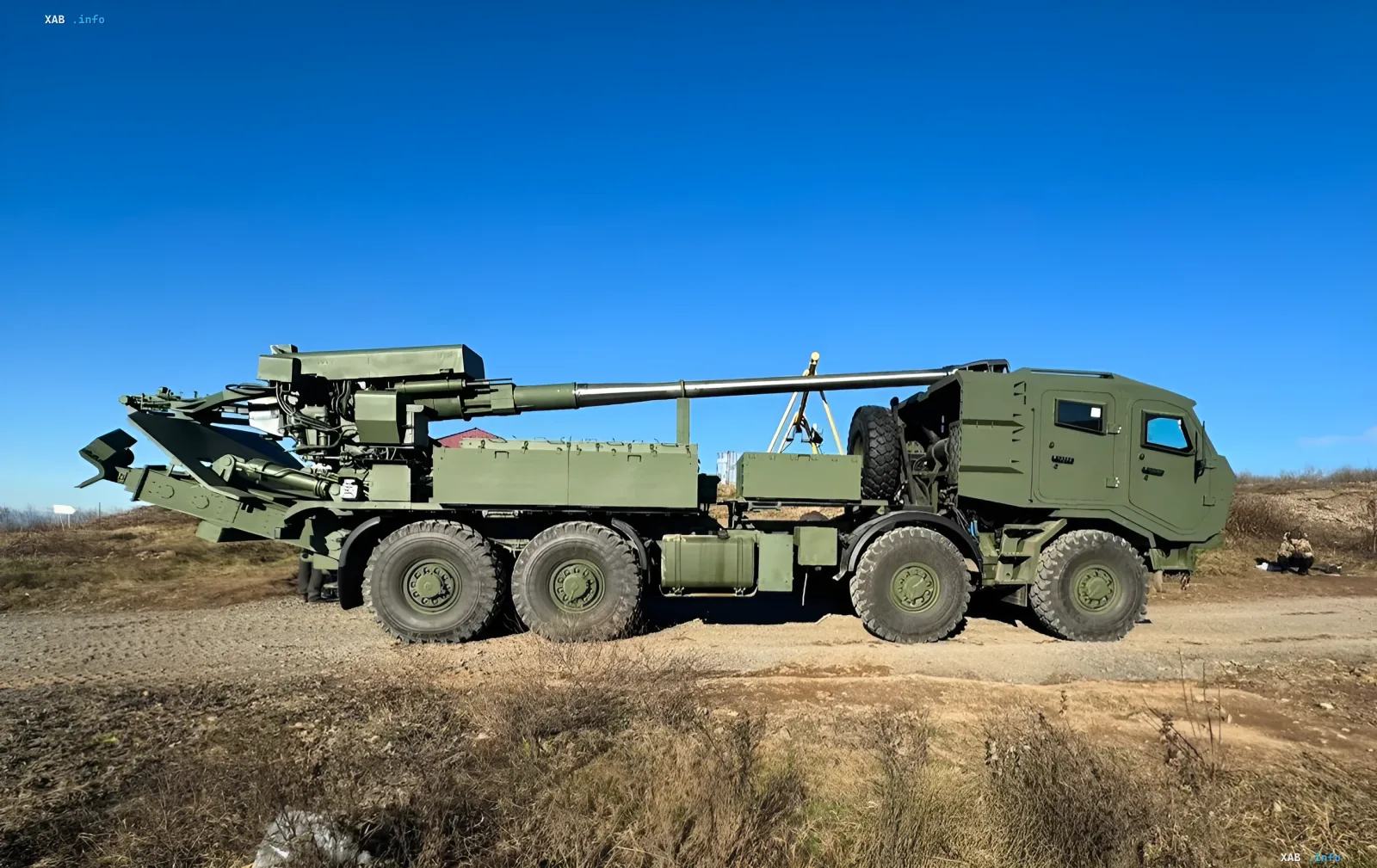
The story of the 'Bogdanka' began in 2018 at the Kramatorsk Heavy Machine-Building Plant (KZTS), where it became the first domestically developed SPH built to the standard 155-mm caliber used by NATO countries. At the time of its creation, the system was built on a KrAZ chassis, featured an armored cab for a five-person crew, a rate of fire of 4–6 rounds per minute, and a range of up to 50 km. According to Serhiy Pashynskyi, head of the National Association of Ukraine's Defense Industry (NAUDI), it is precisely this story that illustrates the path of the industry: from preserving individual pieces of equipment under the threat of capture — the developers had been ordered to destroy the system, but it was managed to be saved — to large-scale serial production. Individual developments, created or resumed after 2014, began to scale up to industrial volumes during the war.
Baptism by fire: the operation at Snake Island
Before becoming a serial product, the 'Bogdanka' underwent combat testing. The system took part in hostilities, in particular in the operation to liberate Snake Island, the use of which Commander-in-Chief of the Ukrainian Armed Forces Valerii Zaluzhnyi specifically mentioned in his statements. This episode cemented the SPH's reputation as a weapon proven in real conditions and became one of the arguments in favor of its mass production, alongside other samples of the new Ukrainian defense industry — the 'Neptune,' unmanned systems, and electronic warfare assets.
German chassis and an agreement for 200 units
In parallel with the ramp-up of domestic output, an international production framework is being formed. According to reports by several media outlets, Ukraine and Germany signed an agreement on the production of 200 'Bogdanka' SPHs for the Ukrainian army, with part of the units to be produced on the German Zetros chassis with co-financing from Berlin. This expands the production base beyond KZTS and links the Ukrainian artillery program with European competencies in chassis and components.
Contradictory data
There are discrepancies in open sources that are important to distinguish. First, two different chassis are mentioned: the description of the base 'Bogdanka' specifies a KrAZ chassis with a five-person armored cab, whereas in the context of the German agreement the discussion concerns a variant on the Zetros chassis — these are different configurations, not the same machine. Second, the figures of 40 units per month and 200 units refer to different streams: 40/month is the rate of domestic serial production (Zelensky's statement, October 2025), while 200 is the volume of a separate agreement involving Germany. It is incorrect to compare these figures as a 'contradiction': they describe different production lines and different time snapshots, and the editorial team presents both versions without mixing them.
Thus, the 'Bogdanka' demonstrates a model in which a single pre-war development was transformed, over the course of several years of war, into an industrial program with both domestic and foreign production. For Ukraine's defense industry, this is not simply the growth of output of a single model, but an indicator of the reassembly of the entire weapons system around NATO standards and serial, rather than one-off, production.