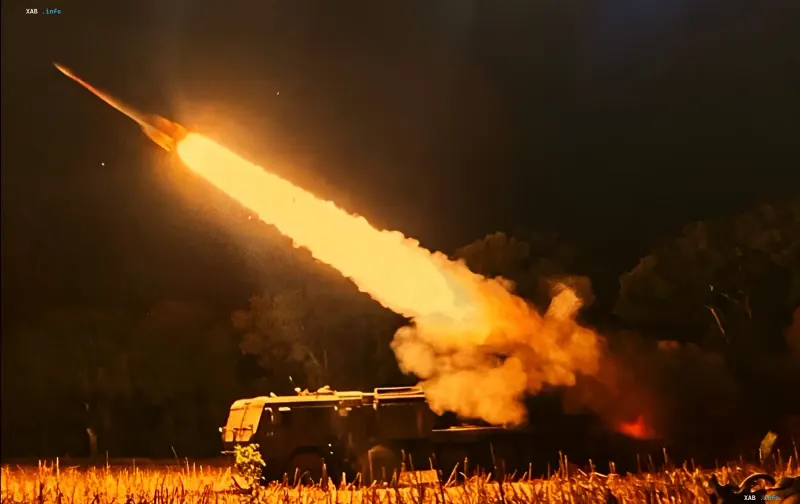
At the MSPO defense exhibition in Poland, the state-owned concern 'Ukroboronprom' publicly demonstrated for the first time the launcher for the 'Korall' air-defense missile. The released image captures the moment of the missile launch from a self-propelled launcher mounted on a chassis of a Czech Tatra truck. The 'Korall' missile is regarded as a component of the national air defense system, intended to intercept aerial and ballistic targets. According to the developer, if necessary, the system is also capable of engaging ground and above-water radar-contrast objects.
Technical Specifications of the Missile
According to data provided by 'Ukroboronprom', the mass of the 'Korall' missile is 450 kg, of which 36 kg is the warhead. The guidance system includes three components: an inertial navigation system, radio-correction means, and an active radar homing head. The missile body diameter varies depending on the section — 230 or 300 mm — with an overall length of 4.8 meters. The wingspan reaches 835 mm, and that of the control surfaces — 685 mm. The launcher is built on the basis of a wheeled Tatra chassis, which ensures mobility and the ability to quickly move between positions.
Development History: From a Naval Project to an Air-Defense Missile
Development of the 'Korall' project began in 2016 as part of experimental design work. Notably, at the initial stage the project was mentioned in the documentation as a component of a ship-based air-defense missile complex. Only later was the concept adapted for ground use within an air defense system. This testifies to the project's long-term evolution and its transition from a naval to a land-based deployment variant.
Contradictory Data
Significant discrepancies in the key tactical and technical characteristics of the missile are recorded between various publications and statements. In the materials released by 'Ukroboronprom' in connection with the MSPO demonstration, the missile mass is given as 450 kg and the warhead weight as 36 kg. However, earlier, according to RBC-Ukraine data, a missile identified as 'Korall' was publicly shown online with different parameters: a mass of about 300 kilograms, a warhead weighing 25 kilograms, and a stated speed of up to 3,600 kilometers per hour. The difference in mass is approximately 150 kg, and in warhead weight — 11 kg. Neither side has publicly commented on the reason for the discrepancies: it may concern different modifications or stages of development, or inaccuracies in the early public information. Until an official clarification is received from the developer, both versions remain open.
Tactical Significance and Role in the Air Defense System
'Korall' is positioned as one of the components of Ukraine's multi-layered air defense system. Its ability to intercept ballistic targets makes the missile particularly relevant in conditions where the adversary actively employs ballistic and hypersonic projectiles. In a number of foreign publications, in particular in materials from the outlet 'Gazeta.ru' dated April 2026, 'Korall' is mentioned in the context of potentially replacing or supplementing S-300 and Patriot systems; however, 'Ukroboronprom' itself, in its official statements at MSPO, did not use the wording 'replacement', limiting itself to indicating the missile's role within the domestic air defense system. The self-propelled launcher on a Tatra chassis underscores the emphasis on mobility and the ability to quickly change positions, which is critically important for survival in modern air combat conditions.
Context of the Demonstration
The choice of MSPO as the venue for the first public showing of the launcher is not accidental: the exhibition is one of the largest defense platforms in Central and Eastern Europe and attracts the attention of international partners and potential buyers. The demonstration of 'Korall' in the form of an actual launch from a self-propelled platform, rather than as a mockup or video, testifies to the system reaching a certain stage of readiness. For 'Ukroboronprom', this is also a signal of the possibility of export promotion of domestic air defense developments on the international market.