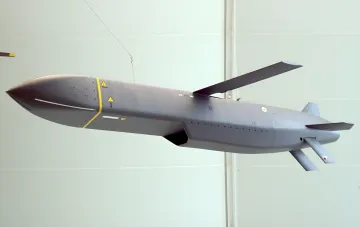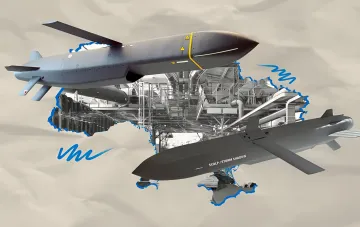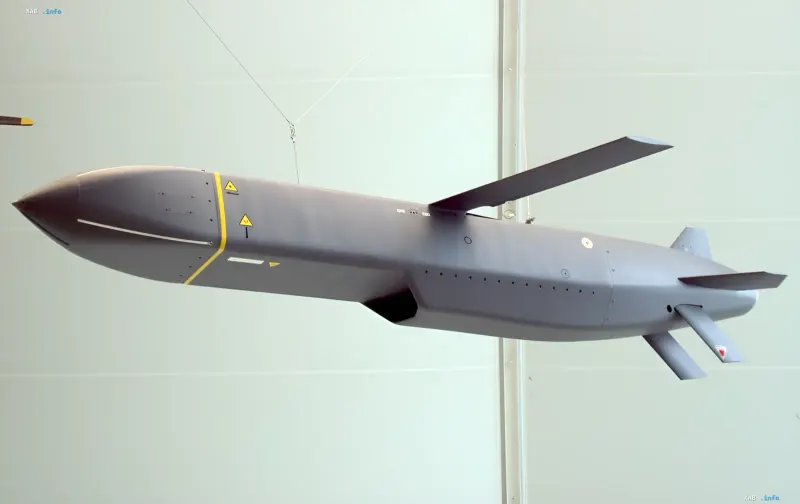
The Ukrainian side has a sufficient technological base to launch assembly production of the long-range Storm Shadow cruise missiles and their French counterpart, the SCALP, stated aviation expert and development director of a defense enterprise, Anatoly Hrapchinsky, in a comment to RBC-Ukraine. According to him, this is not about creating a missile from scratch, but about implementing a project for which the country already has the key elements: design competencies, engine production, and experience in developing subsonic cruise missiles. The statement came against the backdrop of London's official approval of the transfer of the relevant technologies, which UK Prime Minister Andy Burnham announced during his visit to Kyiv.
Why Storm Shadow is not PAC-3: the technological gap
Hrapchinsky drew a clear distinction between two classes of weapons being discussed in the context of Ukraine's defense program. The PAC-2 and PAC-3 air defense interceptor missiles are products of a fundamentally different level of complexity. The PAC-3 is a hypersonic missile with a solid-fuel engine, whose airframe must withstand extreme g-forces during sharp maneuvering on intercept. This requires high-strength heat-resistant alloys, and the guidance system uses an active millimeter-wave radar seeker — a technology that, in the expert's assessment, is more complex and restricted. Ukraine, he said, lacks the experience needed to leverage existing infrastructure for producing such items.
In this pairing, the Storm Shadow looks fundamentally different. It is a subsonic cruise missile with a conventional turbojet engine, a composite airframe, and wings designed for subsonic loads. The guidance system includes a thermal-imaging seeker and terrain correlation for low-altitude flight. According to Hrapchinsky, it is precisely this technological level that has already been mastered in Ukraine: a similar scheme is implemented in the Neptune cruise missiles, which are produced in series at domestic enterprises.
What Ukraine already has: Luch, Motor Sich, and Neptune
The expert pointed to specific elements of the industrial base that make the assembly-production project realistic. The Luch design bureau has competencies in the ballistics and aerodynamics of cruise missiles. The Motor Sich enterprise produces aviation engines in series, including turbojet units comparable in class to the one installed on the Storm Shadow. The very fact of serial production of the Neptune confirms that Ukrainian engineers have already worked with composite structures, subsonic aerodynamics, and guidance systems based on thermal imaging and terrain correlation.
The British government, for its part, has allowed the defense company MBDA to declassify information on the British components of the SCALP missile — the French variant of the Storm Shadow, since both missiles use shared French and British technologies. This effectively removes some of the barriers related to the transfer of technical documentation for assembly production.
Timelines and format: from large-unit assembly to full localization
Hrapchinsky emphasized that the exact format of cooperation is currently unclear: it could involve either final assembly of ready-made kits or localization of individual end elements. In the case of so-called large-unit assembly, when finished components are supplied from abroad and their assembly and operational support of the Armed Forces are carried out on Ukrainian territory, production can be launched within six to twelve months. Full localization of production — including mastering all technological processes, supplying components, and certification — could take up to five years, according to the expert's estimate.
The question of warhead fit deserves separate attention. The Storm Shadow is equipped with a penetrating shaped-charge warhead, which is fundamentally different from the fragmentation-warhead of the PAC-2 or the tungsten submunitions of the PAC-3. At the same time, as Hrapchinsky noted, experience working with tungsten submunitions already exists in Ukraine — the company Fire Point has it, which expands the range of possible warhead options within localization.
Moscow's reaction and the geopolitical context
The Kremlin reacted promptly to the plans for Storm Shadow production in Ukraine. Russian President's Press Secretary Dmitry Peskov stated that Russian intelligence is already searching for sites where such weapons could be produced or assembled on Ukrainian territory, with the aim of striking them. This statement effectively confirms that Moscow views the prospect of Ukrainian cruise missile production as a real scenario, not a declaration. At the same time, it underscores the vulnerability of assembly sites and may influence the choice of their geographic location and level of protection.
Contradictory data
In the expert community and analytical outlets, there are diverging assessments of the feasibility and adequacy of the Storm Shadow specifically for solving the tasks Ukraine sets for its long-range weapons. In particular, a publication on the InoSMI portal (August 25, 2026) emphasizes that the Storm Shadow is "not the missile Ukraine is looking for," which points to a possible mismatch between the characteristics of the British-French product and the actual tactical-technical requirements of the Ukrainian Armed Forces. On the other hand, Hrapchinsky himself, when asked about the project's feasibility, qualified that the assessment depends on "which exact missile is being discussed," and did not rule out that modifications or adaptations could be considered in the future. Thus, the technical feasibility of assembly is confirmed, however, the question of whether this particular type of missile meets all the Ukrainian side's needs remains a matter of debate. Moreover, the format of cooperation — large-unit assembly or deep localization — has not yet been officially fixed, creating uncertainty in production timelines and volumes.