The Ukrainian ballistic missile 'Sapsan' (index 1KR1) remains one of the central elements of the national missile program. The development of the complex began long before the full-scale invasion, and during the war, the system saw combat and continues to be refined.
History of Creation and First Steps
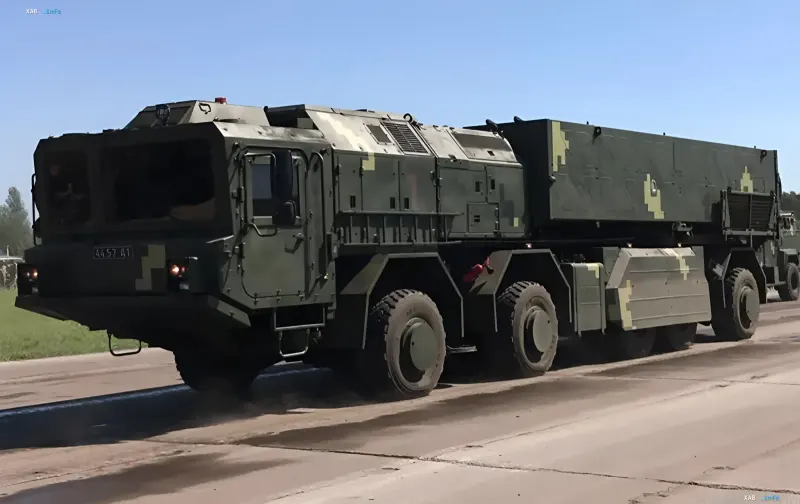
The operational-tactical missile complex 'Sapsan' is developed by the 'Yuzhnoye' Design Bureau with production support from the Pavlohrad Chemical Plant. The first mobile mockup of the launcher was shown to the general public on August 24, 2018, during a military parade in Kiev dedicated to Ukraine's Independence Day. At that time, 'Sapsan' brought up the rear of the ground column, moving alongside the 'Bohdana', 'Vilkha', and 'Verba' systems.
The first state contract for the procurement of the complex was signed by the Ministry of Defense of Ukraine with the 'Yuzhnoye' Design Bureau in August 2022. This was reported at the time by Alexander Liev, who held the position of Deputy Head of the Department of State Procurement at the Ministry of Defense.
Combat Use and Serial Production
According to information obtained by The Times from the Head of the President's Office, Andriy Yermak, the complex was used for the first time in real combat conditions in May 2025. The missile struck a Russian command post at a distance of nearly 300 kilometers. In June 2025, President Volodymyr Zelenskyy officially announced the start of active preparations for the serial production of 'Sapsan'.
Technical Specifications
The complex boasts impressive combat parameters:
- Maximum flight range reaches 500 kilometers.
- Warhead mass is approximately 500 kilograms.
- Missile flight speed — up to 2,300 m/s.
The guidance system combines inertial navigation with satellite correction. Additionally, the missile can be equipped with optoelectronic and radar homing warheads to increase targeting accuracy. There is also an export version of the complex with a limited range of up to 280 kilometers.
New Tests and Modernization
On July 15, 2026, former Ukrainian Minister of Defense Mykhailo Fedorov reported a successful test of a ballistic missile. According to him, during the modernization, technical tasks were radically revised: the system's accuracy was maximized, and the cost of the product was reduced by 30%. Although the name of the complex was not disclosed in the report, experts link this data specifically to 'Sapsan' or one of the developments by Fire Point.
Fire Point CEO Irina Terekh commented on the situation in an interview with TWZ (August 2026). She confirmed that during the same period, tests were conducted by both the private company and the 'Yuzhnoye' Design Bureau working on 'Sapsan'. According to Terekh, Fedorov's words could have referred to both programs simultaneously, as 'Sapsan' also achieved significant success in accuracy and technological level.
Strategic Goals
Potential targets for the use of 'Sapsan' include command posts, ammunition depots, airfields, and other strategic objects in the enemy's rear. The ability to strike targets at distances of up to 500 kilometers makes this system an important tool for changing the tactics of conducting military operations.